Every enterprise rolling out generative AI eventually has the same conversation. Something goes wrong—a chatbot says something it shouldn't, a summarization tool hallucinates a number that ends up in a board deck, an agent takes an action nobody approved—and the response is immediate: "We need guardrails."
Within weeks, a policy document exists. A review checkpoint gets added. Maybe a content filter gets switched on. Everyone feels better.
Then, a few months later, it happens again. Different failure mode, same shock, same scramble. That's when the real problem becomes visible: most organizations don't have a guardrails program. They have a collection of patches, each one shaped by whichever incident triggered it—and none of them built to catch what hasn't happened yet.
The technology to build strong guardrails already exists. What's missing is almost never technical. It's timing.
The Reactive Guardrail Trap
Figure 1. Each patch is shaped by one incident, not the full range of risk.
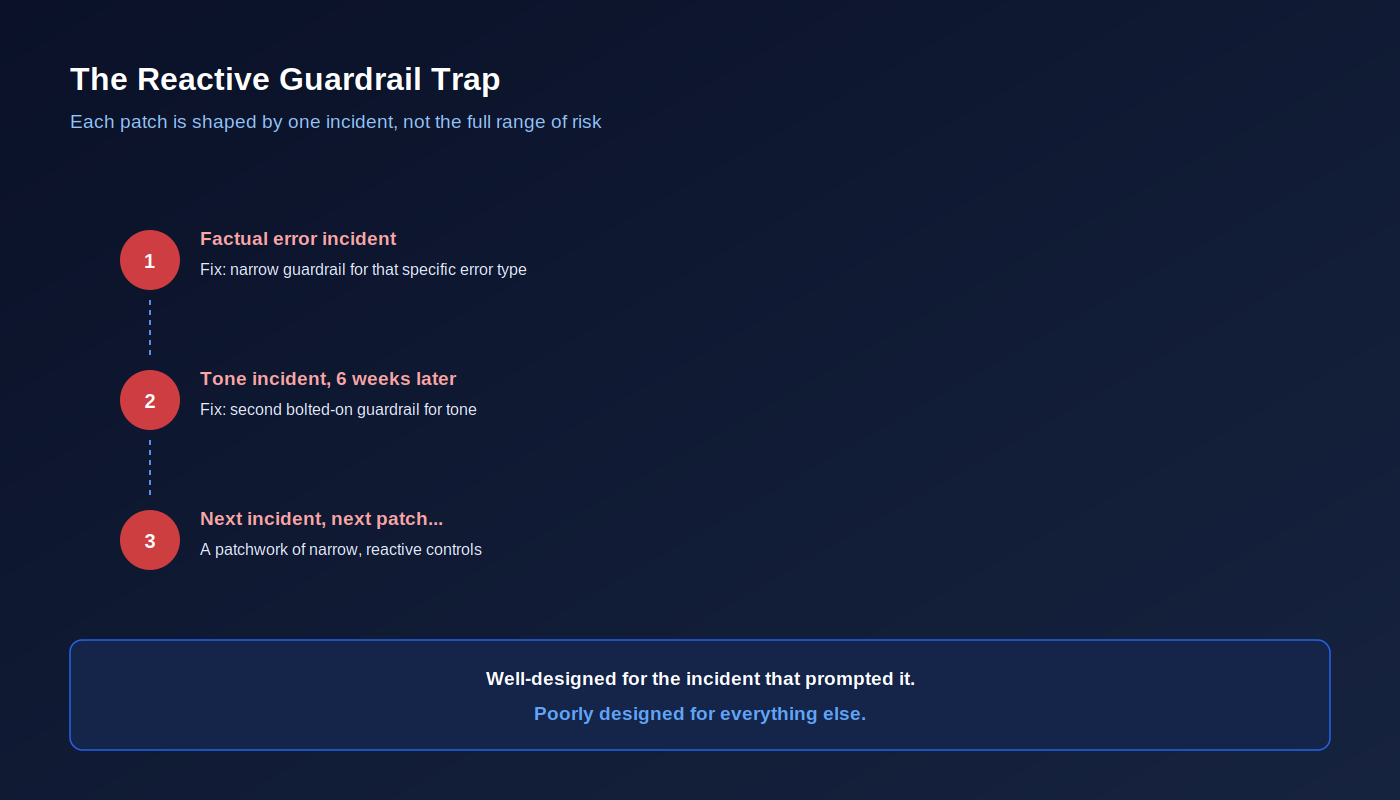
The reactive guardrail trap.
An AI system ships. It works, mostly. Then something goes wrong—say, a factual error slips into a customer-facing response. The fix is narrow and specific: a guardrail is added for that type of error. A few weeks later, a different incident surfaces—this time it's tone, not facts. Another guardrail gets bolted on, just as narrow, just as specific to what already happened.
Repeat this three or four times and you get exactly what you'd expect: a patchwork of controls, each one well-designed for the incident that prompted it, and poorly designed for everything else.
The system isn't more robust. It's more complicated, without being meaningfully safer.
Guardrails Aren't One Thing—They're Four Layers
Figure 2. Most orgs build layer one well—and neglect the two that matter most.
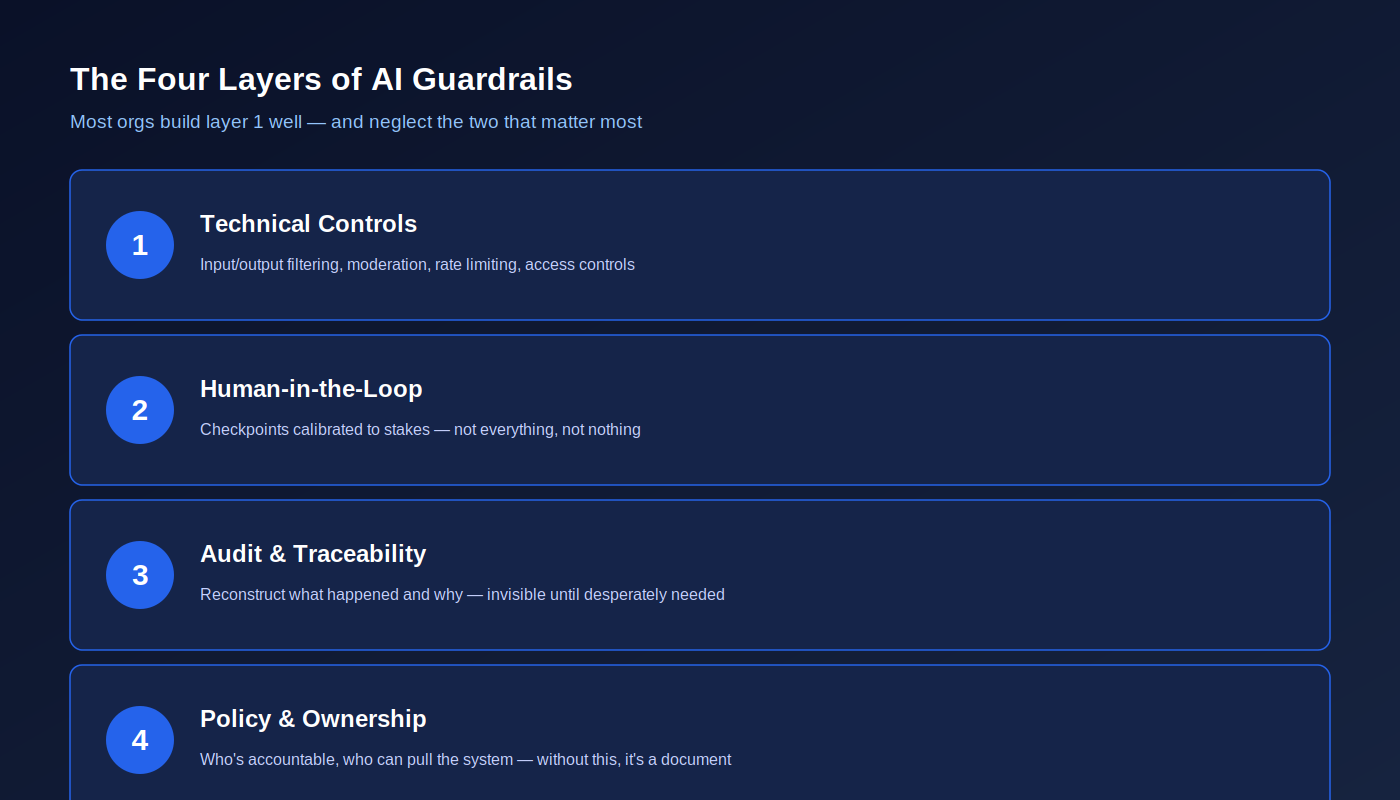
The four layers of AI guardrails.
Part of what makes this hard is that "guardrails" gets used as if it's a single control, when it's really a stack of distinct layers.
Technical Controls — input/output filtering, moderation, rate limiting, access controls. This is the layer vendors sell, so it gets the most budget.
Human-in-the-Loop — checkpoints calibrated to stakes, not applied blanket-wide. Too little oversight and high-risk actions go unchecked; too much and people quietly route around it.
Audit & Traceability — invisible until desperately needed. Without it, an incident review is guesswork.
Policy & Ownership — who's accountable, who can actually pull the system. Without a name attached, it's a document, not a control.
Where it's let orgs down: heavy investment in layer one, an afterthought for the other three—exactly backwards, since layers two through four decide whether an incident gets caught internally or discovered by a customer.
Where Guardrail Programs Actually Fail
Figure 3. Four patterns, independent of industry or company size.
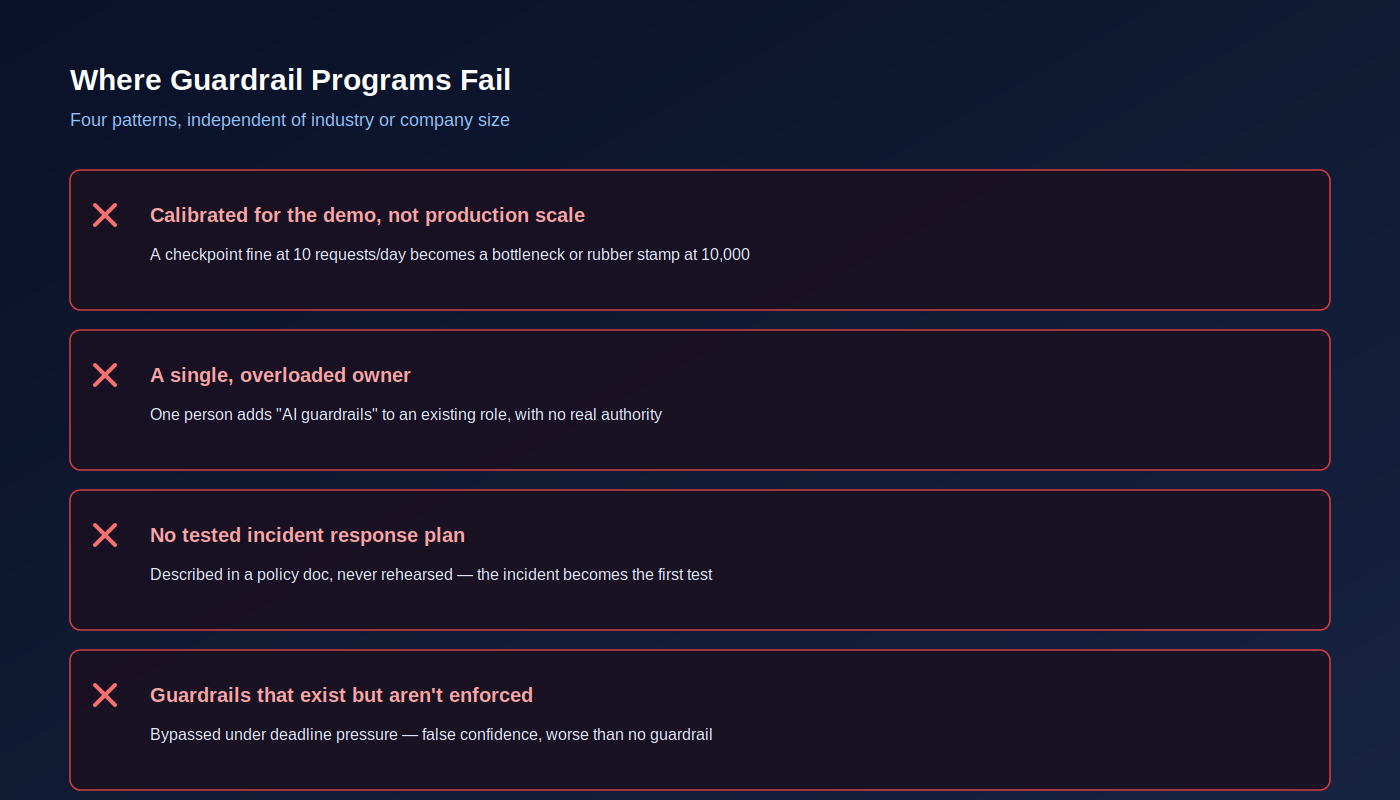
Where guardrail programs fail.
Across the organizations I've seen build—or struggle to build—these programs, the failures cluster around a small number of recurring patterns.
Calibrated for the demo, not production scale. A checkpoint fine at ten requests a day becomes a bottleneck or a rubber stamp at ten thousand.
A single, overloaded owner. One person adds "AI guardrails" to an existing role, with no real authority.
No tested incident response plan. Described in a policy document, never rehearsed—the incident becomes the first test.
Guardrails that exist but aren't enforced. Bypassed under deadline pressure—false confidence, worse than no guardrail.
None of these are technology failures. Every one is a decision about priority, ownership, and timing.
Compliance, Governance, and Guardrails Are Not the Same Thing
Figure 4. Confusing these is one of the most consequential mistakes.
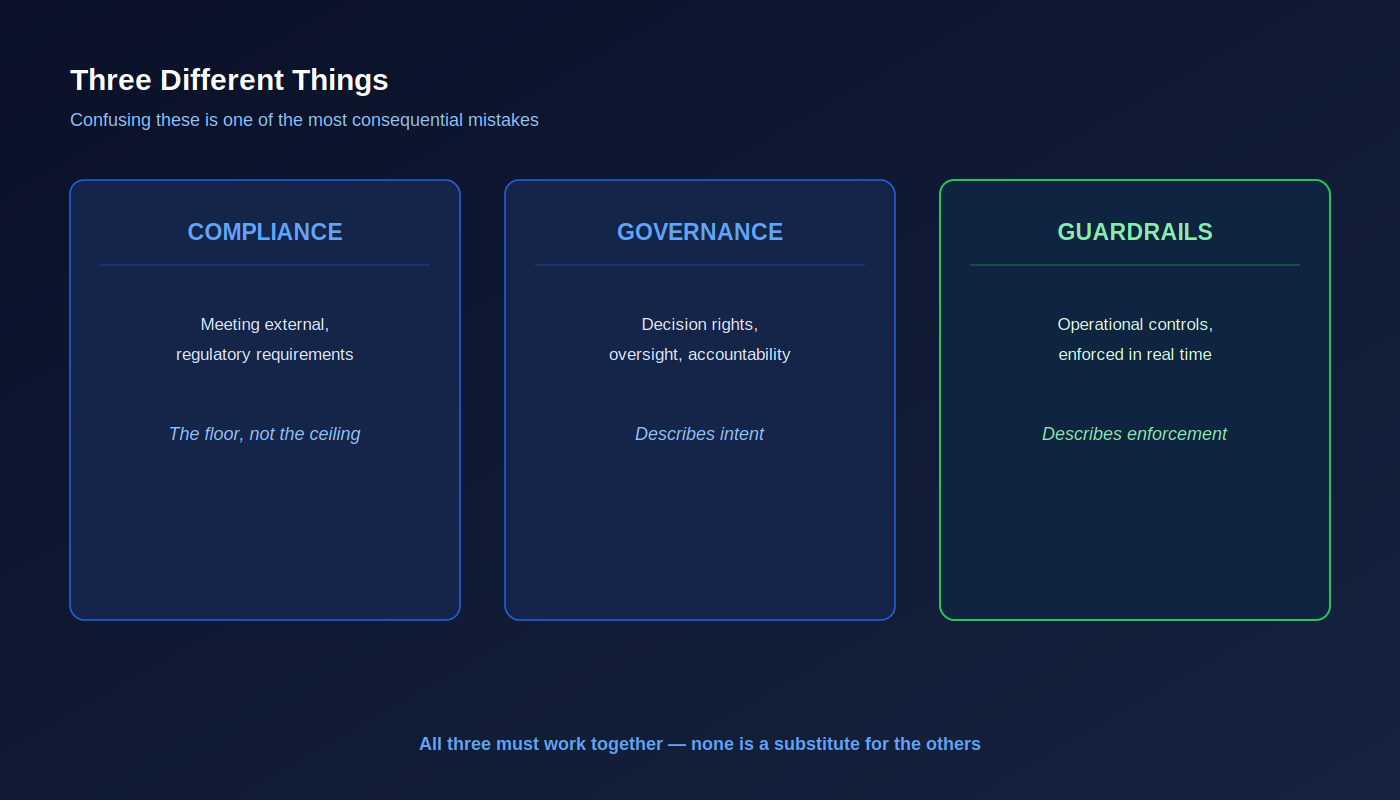
Three different things.
Compliance meets external, regulatory requirements. The floor, not the ceiling.
Governance establishes decision rights and accountability. It describes intent.
Guardrails are operational controls, enforced in real time. This is the only one of the three that actually intervenes.
An organization can be fully compliant, with a polished governance framework, and still have no functioning guardrails—because compliance and governance describe what should happen, while guardrails are what actually enforces it. All three are necessary. None substitutes for the others.
Building Guardrails In From Day One
Figure 5. A pre-deployment checklist, not a post-incident one.
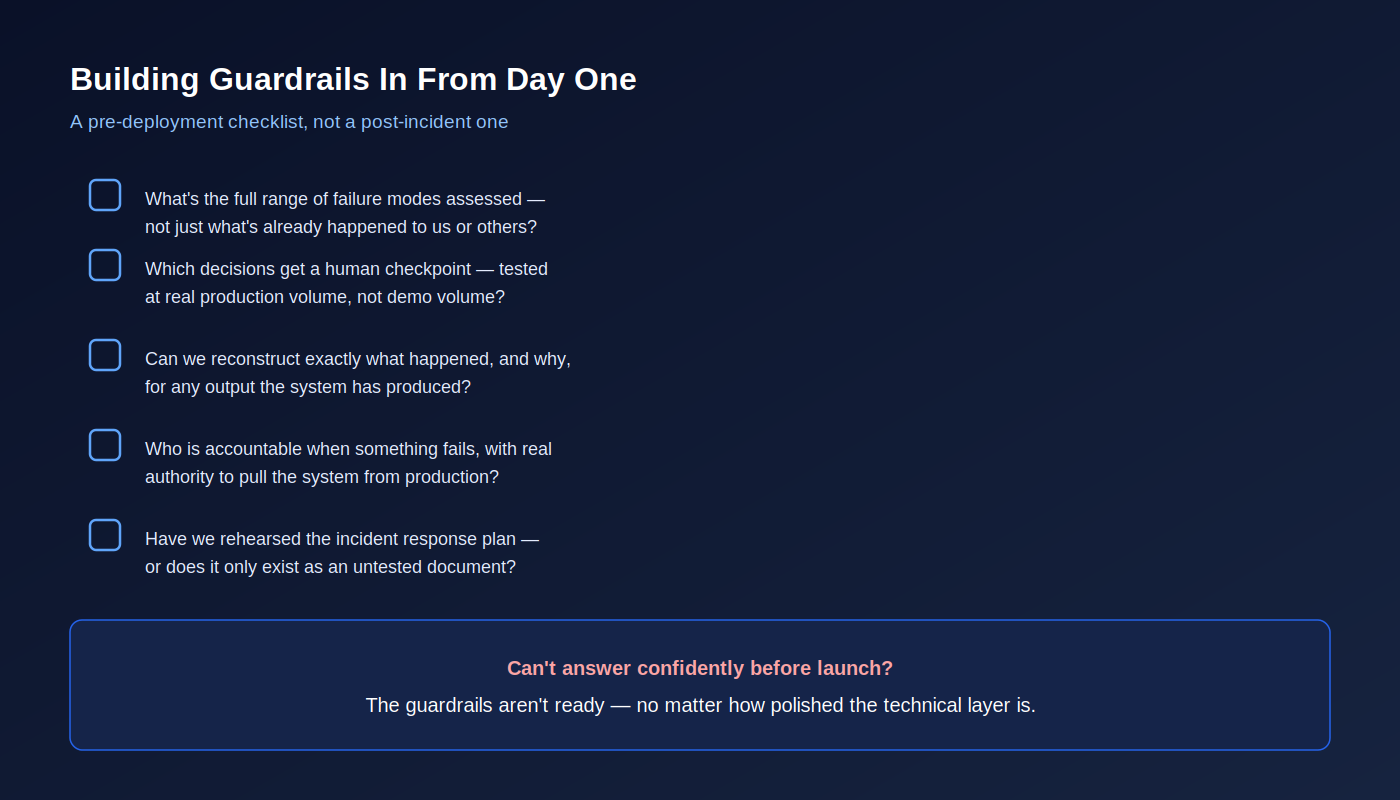
Building guardrails in from day one.
Before a system goes live, leadership should be able to answer, with confidence:
- What's the full range of failure modes assessed—not just what's already happened to us or others?
- Which decisions get a human checkpoint—tested at real production volume, not demo volume?
- Can we reconstruct exactly what happened, and why, for any output the system has produced?
- Who is accountable when something fails, with real authority to pull the system from production?
- Have we rehearsed the incident response plan—or does it only exist as an untested document?
Can't answer confidently before launch? The guardrails aren't ready—no matter how polished the technical layer is.
Final Thought
Every organization I've watched get this right didn't necessarily have better technology than the ones that got it wrong. They moved the guardrails conversation earlier—from "what do we patch after this incident" to "what do we need to have answered before this ships."
That's the timing problem, and it's entirely within leadership's control to fix.
If an incident happened in your organization tomorrow, would your guardrails have caught it—or would they be built the week after?
About the Author
Arindam Banerjee is a technology executive with more than 21 years of experience leading enterprise technology transformation, AI strategy, digital transformation, and large-scale delivery across global organisations.
If your organization is navigating AI governance and guardrails, I'd be glad to connect and exchange ideas.