Most enterprises don't have an AI problem.
They have an AI coordination problem.
Walk into almost any large organisation experimenting with AI today and you'll find the same pattern:
- Five teams quietly building five versions of the same chatbot.
- Duplicated spend on overlapping tools and licences.
- No shared standards for data access or risk review.
- Every new pilot starting from zero because nothing from the previous initiative was captured or reused.
This isn't a technology failure.
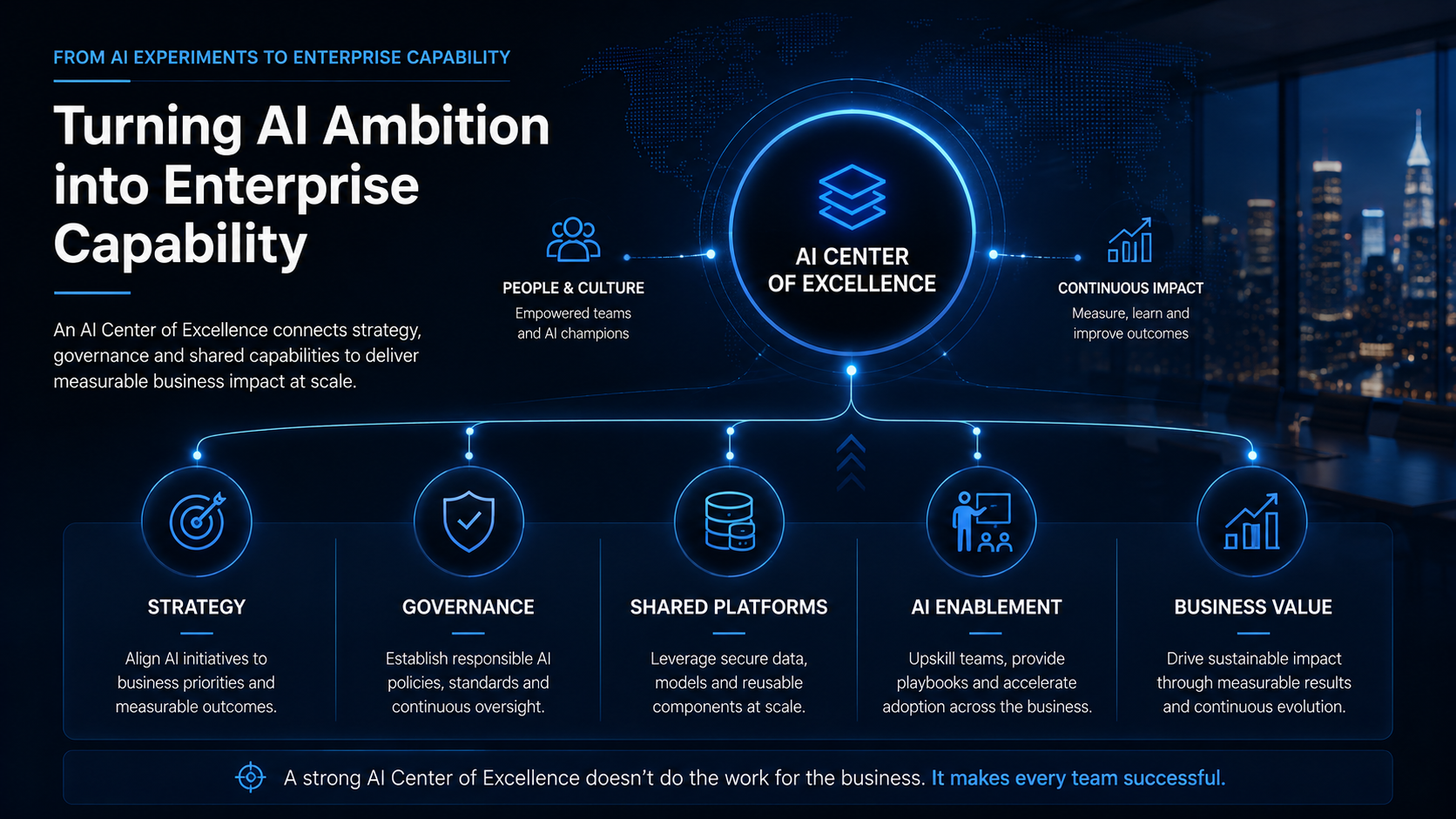
It's an operating model failure—and it's exactly the gap an AI Center of Excellence (CoE) is supposed to close.
The problem is, most CoEs don't close it.
They become exactly the kind of bottleneck—or free-for-all—they were meant to prevent.
After leading technology transformation programmes for more than two decades, I've seen this pattern repeatedly, and I've also seen what organisations that succeed consistently do differently.
What an AI Center of Excellence Actually Is
Let's begin with what it isn't.
An AI Center of Excellence is not:
- A research lab disconnected from business priorities.
- A governance committee whose only purpose is approving or rejecting projects.
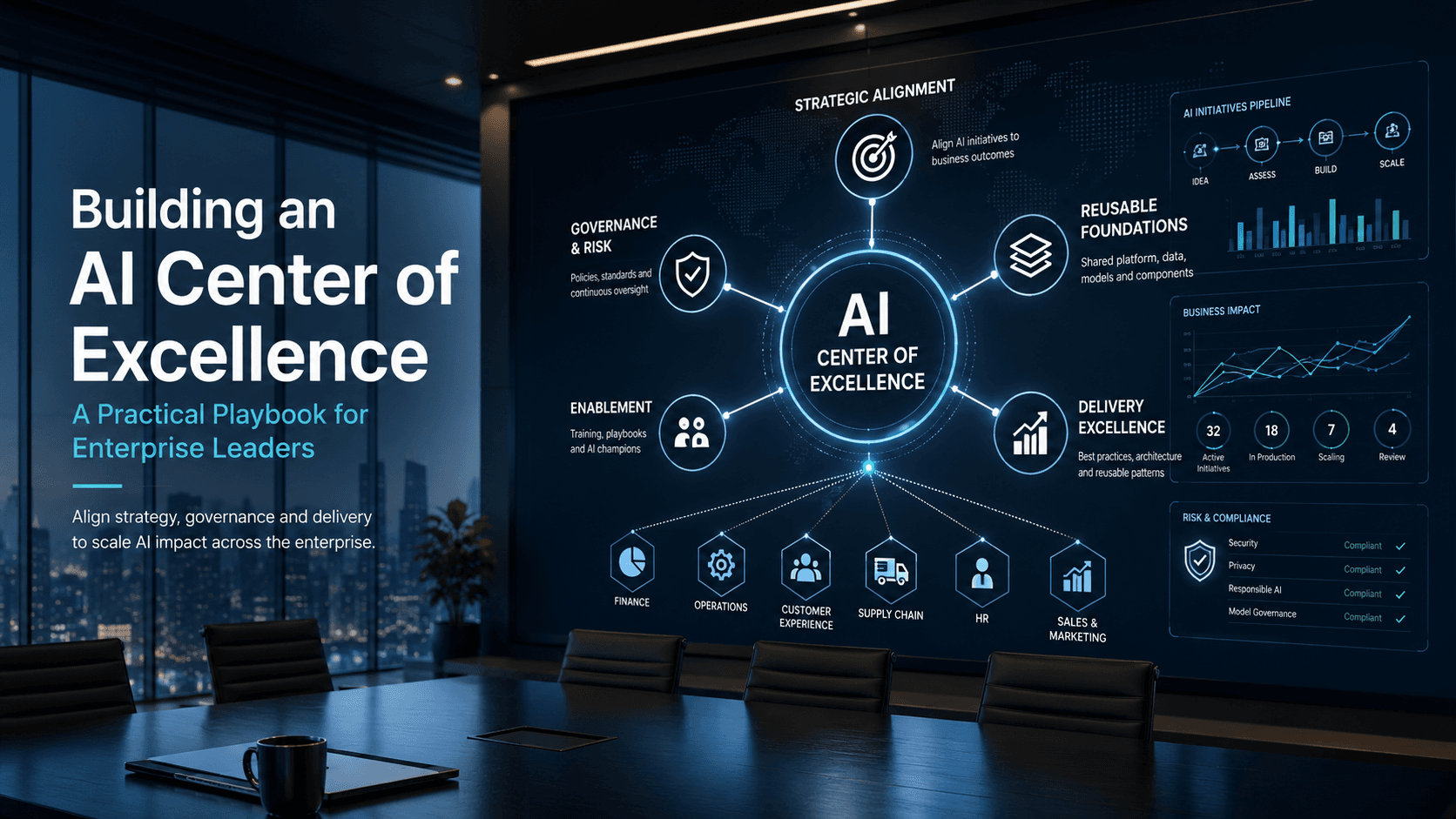
Instead, an effective AI CoE acts as the connective tissue between:
- Strategy
- Governance
- Execution
Business units still own their business outcomes and use cases.
The CoE ensures that teams don't repeatedly:
- Build identical technical foundations.
- Negotiate the same vendor contracts.
- Rediscover compliance requirements.
- Reinvent common AI capabilities.
Get this distinction right, and almost every other design decision becomes significantly easier.
The Four Pillars of an Effective AI CoE
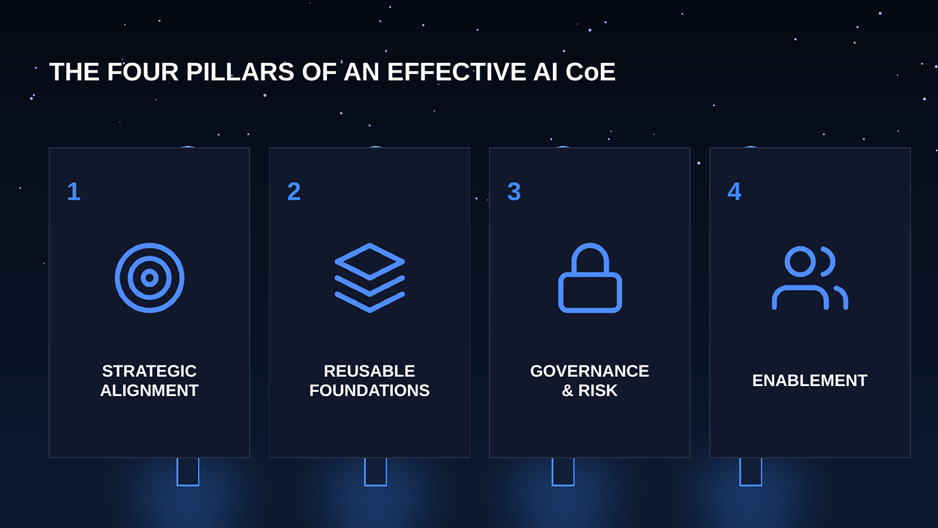
Every successful AI Center of Excellence I've encountered shares four characteristics.
Remove any one of them, and the remaining three gradually weaken.
1. Strategic Alignment
Every AI initiative should map directly to a measurable business outcome.
Each initiative should have:
- An executive sponsor accountable for business value.
- Clear prioritisation criteria.
- Funding based on business impact and feasibility—not enthusiasm.
Without this discipline, resources inevitably flow toward the loudest stakeholders rather than the highest-value opportunities.
2. Reusable Foundations
This forms the operational heart of the CoE.
The organisation should provide shared assets including:
- Enterprise data platform
- Approved AI models
- Approved vendors
- Prompt libraries
- Retrieval-Augmented Generation (RAG) patterns
- Evaluation frameworks
- Reusable components
The greatest benefit of a mature AI CoE isn't governance.
It's enabling the tenth project to begin from an existing foundation instead of another blank page.
3. Governance & Risk
Security, privacy and responsible AI should follow one consistent policy across every business unit.
Governance cannot be a single approval gate at project initiation.
Instead, it must continuously evolve alongside:
- Models
- Data sources
- Regulations
- Business usage
Organisations that treat governance as a one-time approval frequently discover that systems compliant at launch drift out of compliance within months.
4. Enablement
Successful CoEs invest heavily in:
- Training
- Playbooks
- Communities of practice
- Embedded AI Champions
These champions understand local business priorities while remaining closely connected to the central CoE.
A CoE that scales solely through committee approvals becomes a bottleneck.
A CoE that scales through capable people embedded across the organisation scales with the business itself.
Where Most AI Centers of Excellence Fail
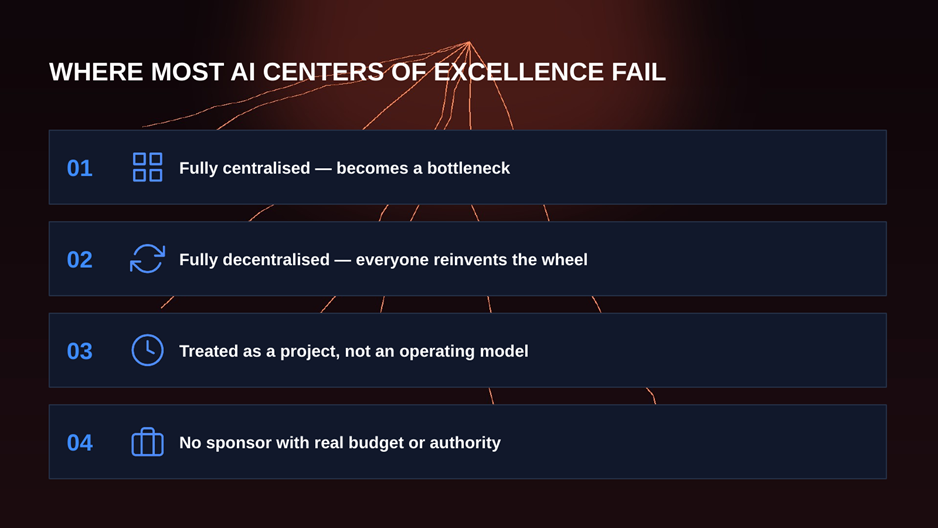
Across organisations, four failure patterns appear repeatedly.
Fully Centralised
Every request passes through one central team.
That team rapidly becomes the bottleneck.
Momentum quietly disappears.
Fully Decentralised
The opposite problem.
Every business unit independently:
- Selects vendors.
- Builds data pipelines.
- Creates governance processes.
- Manages risk.
This appears to create agility.
In reality it creates duplicated cost, fragmented architecture and inconsistent risk exposure.
Treated as a Project Instead of an Operating Model
Many organisations fund an AI CoE for twelve months.
Several pilots are delivered.
Funding ends.
People move elsewhere.
Institutional knowledge disappears with them.
The CoE was never designed to become part of the organisation's operating model.
No Executive Sponsor with Real Authority
Perhaps the most common failure.
Talented people.
Good intentions.
No executive with:
- Budget authority
- Decision-making authority
- Organisational influence
Without sponsorship, the CoE becomes a discussion forum instead of an enterprise capability.
Every one of these failures is fundamentally a leadership failure—not an AI failure.
None are solved simply by choosing a better model or increasing the budget.
The Operating Model That Works: A Federated Structure
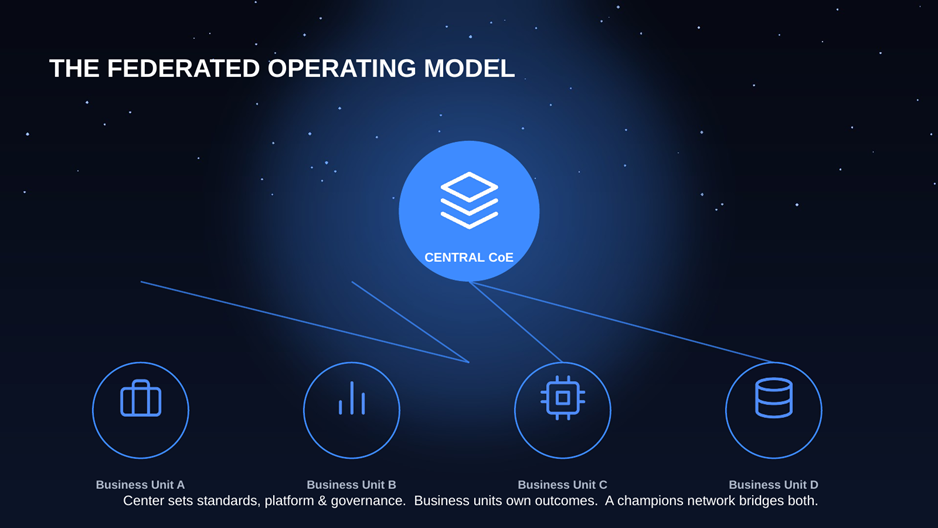
The organisations I've seen scale AI capability successfully almost always converge on some variation of a federated, hub-and-spoke operating model.
The model deliberately separates enterprise responsibilities from business ownership.
The Central CoE Owns
The AI Center of Excellence is responsible for:
- Enterprise standards
- Shared platforms
- Reusable AI components
- Governance
- Security
- Risk management
- Vendor standards
- AI operating principles
It provides the foundation on which everyone else builds.
It does not own individual business use cases.
Business Units Own
Business units remain accountable for:
- Business problems
- Use cases
- Value delivery
- Adoption
- Operational ownership
- Business outcomes
The objective is not to centralise delivery.
The objective is to standardise the foundations while decentralising innovation.
AI Champions Connect Both Worlds
A successful federated model relies on embedded AI Champions.
These individuals:
- Understand local business priorities.
- Promote enterprise standards.
- Share successful patterns.
- Bring practical feedback back into the CoE.
Rather than every decision flowing through a central committee, knowledge flows continuously across the organisation.
The result is an operating model that is:
- Decentralised enough to move quickly.
- Centralised enough to avoid duplicated effort and unmanaged risk.
The CoE Charter: What It Should Actually Contain
If you're establishing an AI Center of Excellence, the charter is the document that prevents the organisation drifting into one of the failure patterns discussed earlier.
At a minimum, it should define:
- Purpose and scope — what the CoE is accountable for and, equally importantly, what it is not accountable for.
- Governance structure — steering committee membership, meeting cadence and decision-making responsibilities.
- RACI across the federated model — clearly defining who is Responsible, Accountable, Consulted and Informed across each of the four pillars.
- Success metrics — agreed before launch rather than created afterwards to justify investment.
- Review cadence — governance should evolve continuously as technology, regulation and organisational priorities change.
A strong charter protects the CoE from becoming either an innovation bottleneck or an unfocused collection of disconnected initiatives.
A 90-Day Launch Plan
Standing up an AI Center of Excellence does not require a year-long transformation programme.
A focused ninety-day plan is sufficient to establish the foundations.
Days 1–30 — Foundation
- Secure an executive sponsor with genuine budget authority.
- Draft and ratify the CoE Charter.
- Identify two or three business units for initial collaboration.
- Define governance principles and operating model.
Days 31–60 — Build the Shared Foundation
- Establish the enterprise AI platform.
- Publish the approved model and vendor catalogue.
- Release Version 1 of the governance framework.
- Recruit and train the first cohort of AI Champions.
Days 61–90 — Demonstrate Value
Launch two or three real business initiatives using the new operating model.
Measure:
- What was reused.
- What was newly developed.
- Delivery speed.
- Business outcomes.
- Lessons learned.
The objective isn't to finish building the CoE.
The objective is to demonstrate that the operating model works and deserves continued investment.
The Metrics That Prove It's Working
Many organisations measure activity.
Few measure effectiveness.
The following metrics provide a far more meaningful view of whether an AI Center of Excellence is creating enterprise value.
Reuse Rate
What percentage of new AI initiatives build on existing shared assets rather than starting from scratch?
Higher reuse indicates that the CoE is successfully creating enterprise leverage.
Time-to-Production
How quickly can an approved AI initiative move from concept to production?
A mature CoE should reduce this over time through reusable platforms and standardised delivery.
Risk Incidents
How many governance, security or compliance issues are identified before deployment compared with after deployment?
Effective governance catches issues early.
Business Outcome Achievement
Did each initiative actually achieve the business outcome originally approved?
Shipping technology is not the objective.
Delivering measurable business value is.
If these four metrics cannot be reported consistently, the AI Center of Excellence is unlikely to be operating as intended—regardless of how many pilots are underway.
Final Thought
A Center of Excellence isn't where AI lives.
It's how good AI decisions scale across the organisation—or fail to.
The technology will continue to evolve.
Whether your organisation captures compounding value from AI or continues restarting every initiative from scratch depends far more on the operating model than on the models themselves.
Technology changes rapidly.
Well-designed operating models endure.
About the Author
Arindam Banerjee is a technology executive with more than 21 years of experience leading enterprise technology transformation, AI strategy, digital transformation and large-scale delivery across global organisations.
His experience spans enterprise architecture, programme delivery, AI adoption and technology leadership across banking, manufacturing, consumer products and digital businesses.
He has led complex technology transformation initiatives, built high-performing delivery organisations and helped businesses adopt emerging technologies with a focus on measurable business outcomes.
If you're building or scaling AI capabilities within your organisation, I'd be delighted to connect and exchange ideas.