
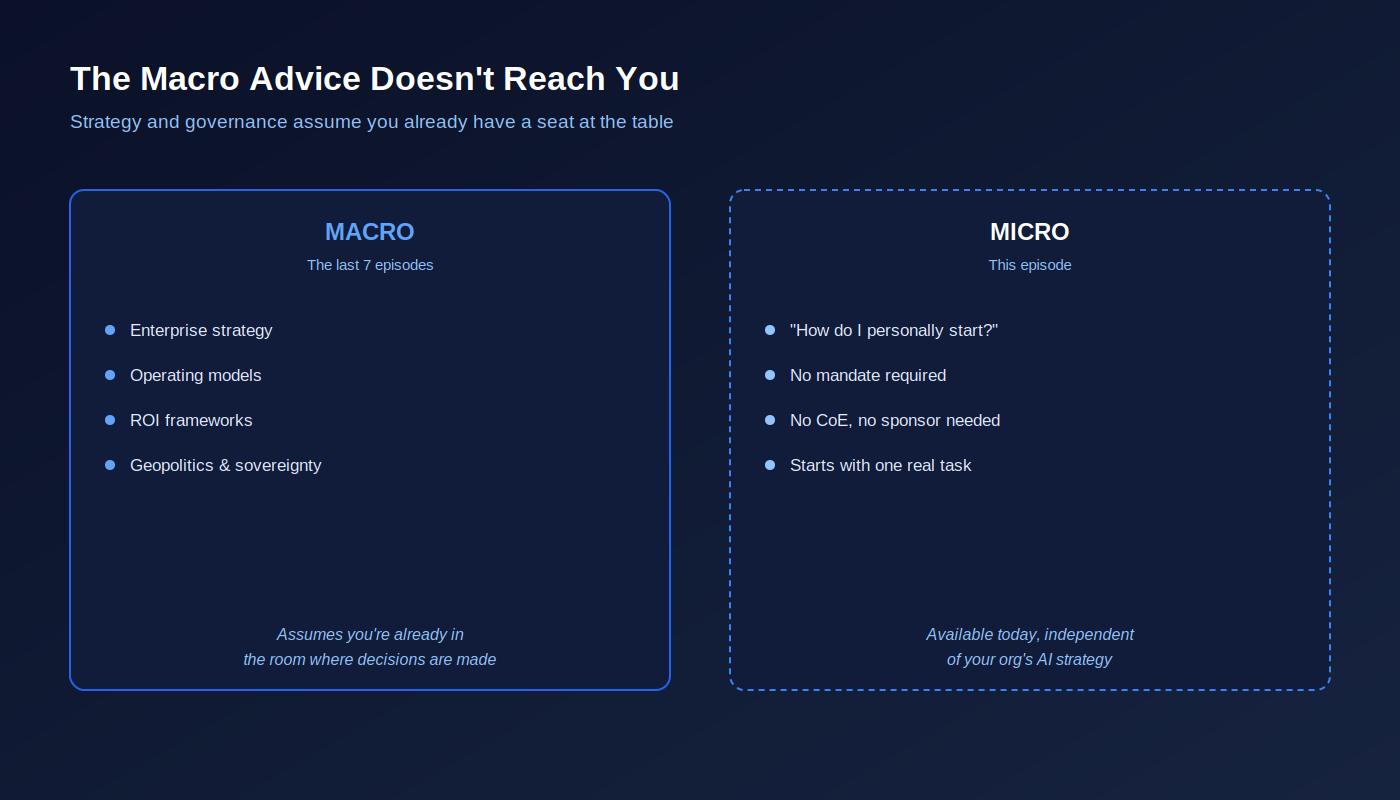
Seven episodes into this series, and every single one has been about the macro picture. Enterprise strategy. Operating models. ROI frameworks. Geopolitics.
All useful. None of it answers the question I get asked more than any other — usually after a talk, or in a DM, never in a boardroom:
"Okay, but how do I actually get started with this myself?"
Not "how does my company adopt AI." "How do I personally become someone who's genuinely useful in an AI-shaped world?"
That's a completely different question, asked by a completely different audience — and after seven episodes aimed at executives, it deserves its own, much more practical answer.
Why the Macro Advice Doesn't Help You Personally
Everything at the organisational level — strategy, governance, operating models, executive sponsorship — assumes you already have a seat at a table where those decisions get made.
Most people don't. Most people are individual contributors, managers, or specialists watching AI reshape their function from the inside, without a mandate to redesign anything. They don't need a Center of Excellence. They need a personal starting point that doesn't require permission from anyone above them.
And the honest problem isn't lack of resources. It's the opposite.
There are thousands of courses, certifications, "AI roadmaps," and LinkedIn carousels promising to make you "AI-ready" in 30 days. Almost all of that noise leads to the same outcome: analysis paralysis. People consume content about AI for months — bookmarking articles, starting courses they don't finish, collecting prompts they never use — without ever touching a real task differently.
The problem was never information. It's sequencing. And underneath the sequencing problem is a deeper one: most of this content is written for beginners who've never had to apply anything under real stakes. It teaches you to talk about AI, not to work with it.
This piece is about fixing the sequencing.
The Four Stages of a Personal AI Transition
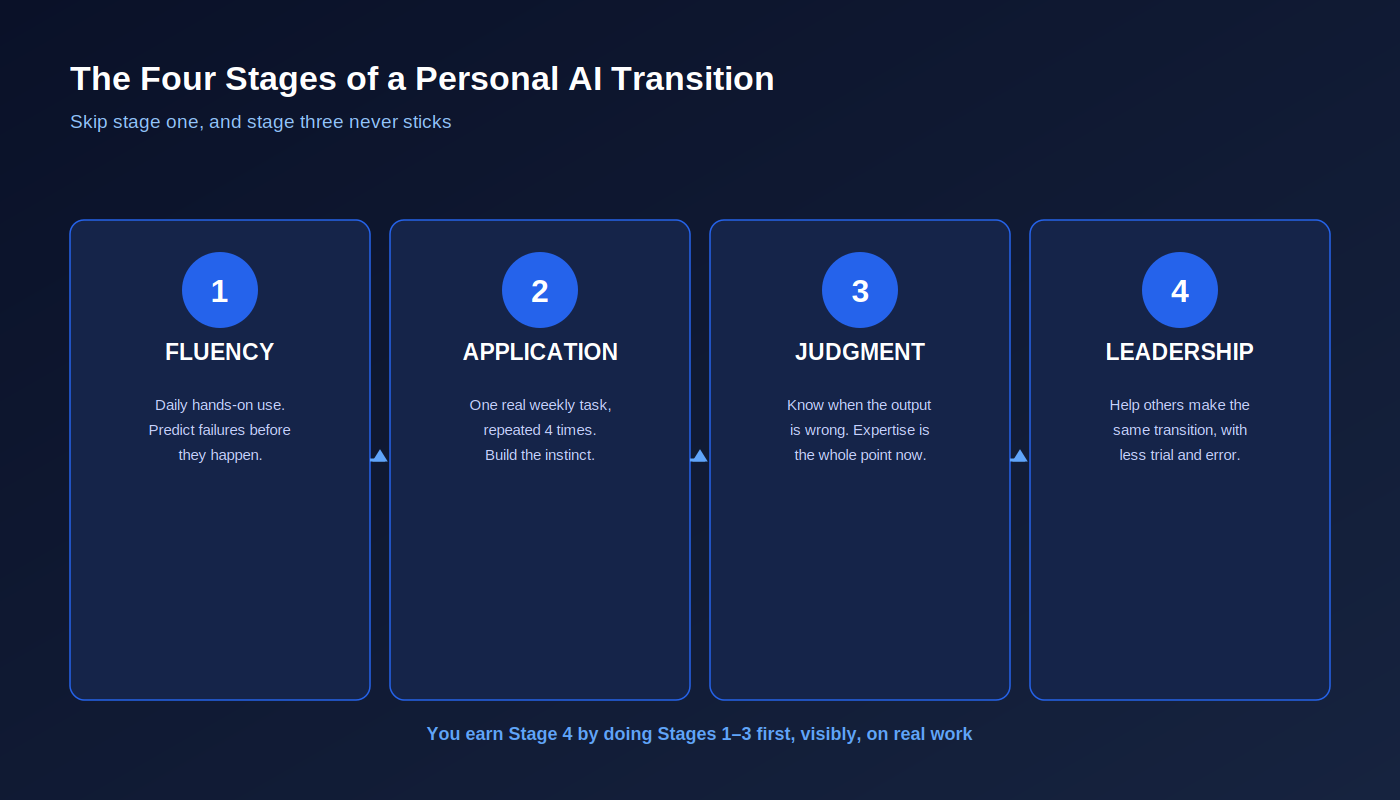
I've watched a lot of people attempt this transition — on my own teams, across client organisations, and through conversations after talks. The ones who actually change how they work go through four stages, in this order. The ones who stall almost always tried to skip stage one, or attempted stage three without ever completing stage two.
Stage 1 — Fluency
Before you build anything, you need working fluency: understanding what these tools are actually good at, where they reliably fail, and enough vocabulary to reason about them — prompting, context windows, hallucination, retrieval, agents — whichever concepts are relevant to your world.
This isn't a certificate, and it isn't a weekend course. It's daily, hands-on use of the tools that already exist, inside your actual work, not a sandbox exercise disconnected from anything real.
Fluency has a specific failure mode worth naming: vocabulary without contact. You can learn every term — RAG, fine-tuning, chain-of-thought — and still have never once used any of it to change a real decision. That's not fluency. That's trivia. The test of fluency isn't whether you can define a term. It's whether you can predict, before you try something, whether it's likely to work.
What fluency actually looks like in practice:
- You can predict, roughly, what a tool will be bad at before you try it — not just discover it after
- You know the difference between a tool that retrieves information and one that generates it, and why that distinction matters for trusting the output
- You've had at least one moment where a confidently wrong AI answer nearly misled you — and you caught it
Stage 2 — Application
This is where most people stall. Fluency without application evaporates within weeks, because there's no repetition to make it durable.
Pick one real, recurring task in your job — something you do weekly — and use AI to do it differently. Not faster. Differently. A status report, a first-draft analysis, a research summary, a block of code, a customer response. The goal at this stage isn't efficiency. It's building the instinct for when to reach for these tools and when not to — which only comes from repetition against real stakes, not tutorials.
A pattern I see constantly: people apply AI to the task that's easiest to demo, not the task that's actually recurring and valuable. A flashy one-off demo teaches you almost nothing, because you never do it again. Pick boring, repeated work instead. Boring and repeated is where the instinct actually forms.
A concrete way to structure this stage:
- Choose one weekly task — not your hardest task, your most frequent one
- Do it with AI assistance for four consecutive occurrences, not once
- After each attempt, write down one thing that worked and one thing that didn't — this is the step almost everyone skips, and it's the one doing most of the learning
- By the fourth attempt, you should be able to predict, before you start, roughly how much the tool will help this time
If you can't yet predict that after four tries, stay on this task longer before moving to a new one. Breadth before depth is how people end up with shallow exposure to twenty tools and real competence with none.
Stage 3 — Judgment
This is the stage almost nobody talks about, and it's the one that actually separates people who are "AI-literate" from people who are genuinely valuable in an AI-shaped role.
Judgment is knowing when the AI's output is wrong, incomplete, or subtly misleading — and having the underlying domain expertise to catch it before it causes damage. This is precisely why deep domain knowledge doesn't become obsolete with AI. It becomes the entire point. The tools amplify judgment; they don't replace the need for it. A brilliant AI output evaluated by someone without the expertise to check it is not a safe output — it's an unverified guess with better production values.
This is also where the earlier "boring, repeated task" advice pays off. Judgment isn't built by reading about failure modes. It's built by personally encountering enough real failures — a confidently wrong summary, a plausible-sounding but incorrect calculation, a fabricated citation — that you develop a reflexive sense for where the danger usually hides in your specific domain.
Three questions that build judgment faster than almost anything else:
- When this is wrong, what does "wrong" typically look like — confidently incomplete, subtly outdated, plausible but fabricated, or something else?
- What's the smallest check I can do that would catch most of the failure cases I've personally seen?
- Am I reviewing this output with the same rigor I'd apply to a junior colleague's first draft, or am I extending it more trust than it's earned?
Judgment also means knowing where AI assistance is simply the wrong tool — not everything benefits from it, and knowing which tasks to leave alone is itself a form of expertise.
Stage 4 — Leadership
Once you have fluency, application, and judgment, you're in a position to help others — your team, your function, your organisation — make the same transition, with far less trial and error than you went through yourself.
This is where "macro" and "micro" reconnect. Individuals who've done this work personally are exactly the people organisations need leading their Centers of Excellence, sponsoring their pilots, running their change management. Every framework I've written about in this series — the Iceberg, the CoE operating model, the ROI layers — is eventually implemented by people who had to go through these first three stages themselves before they could credibly lead anyone else through them.
You don't get invited to lead the macro conversation. You earn it by doing the micro work first, visibly, on real tasks, long enough to have real opinions about what works.
Common Mistakes That Stall the Transition
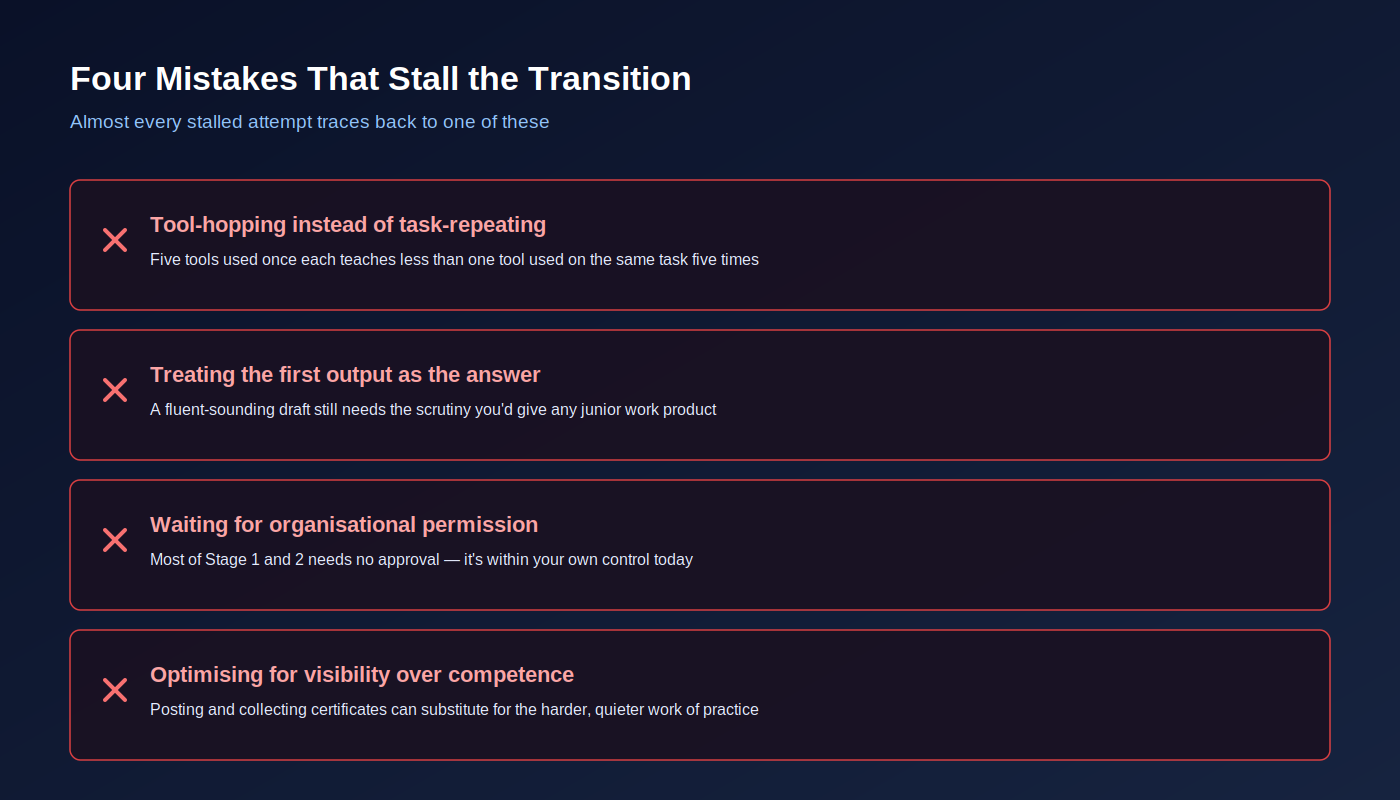
Beyond skipping stages, there are a handful of specific mistakes I see repeatedly:
Tool-hopping instead of task-repeating. Trying five different AI tools once each teaches you less than using one tool on the same task five times. Depth on a narrow, real problem builds transferable judgment. Breadth across demos builds trivia.
Treating the first output as the answer. The instinct to accept a fluent-sounding first draft is strong, especially under time pressure. The people who build real judgment treat the first output as a first draft requiring the same scrutiny they'd apply to any junior work product — not less, because it sounds confident.
Waiting for organisational permission. "My company hasn't rolled out an official AI tool yet" is a common reason people give for not starting. It's rarely a real blocker — most of Stage 1 and Stage 2 can happen with tools you already have access to, on tasks that are entirely within your own control.
Optimising for visibility over competence. Posting about AI, attending webinars, and collecting certificates are visible activities that can substitute for the much less visible, much more valuable work of actually sitting with a real task and getting it wrong a few times before getting it right.
What This Doesn't Require
To be equally clear about what's not on the critical path, because the noise around AI upskilling tends to inflate the prerequisites:
- A machine learning or data science degree, unless your target role specifically and structurally requires one
- Learning to build models from scratch — almost nobody needs this to be effective using AI in their job
- Chasing every new tool that launches — tool-chasing is a distraction from building judgment, not a substitute for it
- Waiting for your organisation to "roll out an AI strategy" before you personally start
- Becoming an expert in the underlying mathematics — useful for a narrow set of roles, unnecessary for the vast majority of people trying to become effective users and evaluators
The transition is personal, and it's available today, entirely independent of what your organisation has or hasn't decided about its own AI strategy.
A Role-Specific Starting Point
Not everyone is starting from the same place. A few honest starting points, depending on where you sit:
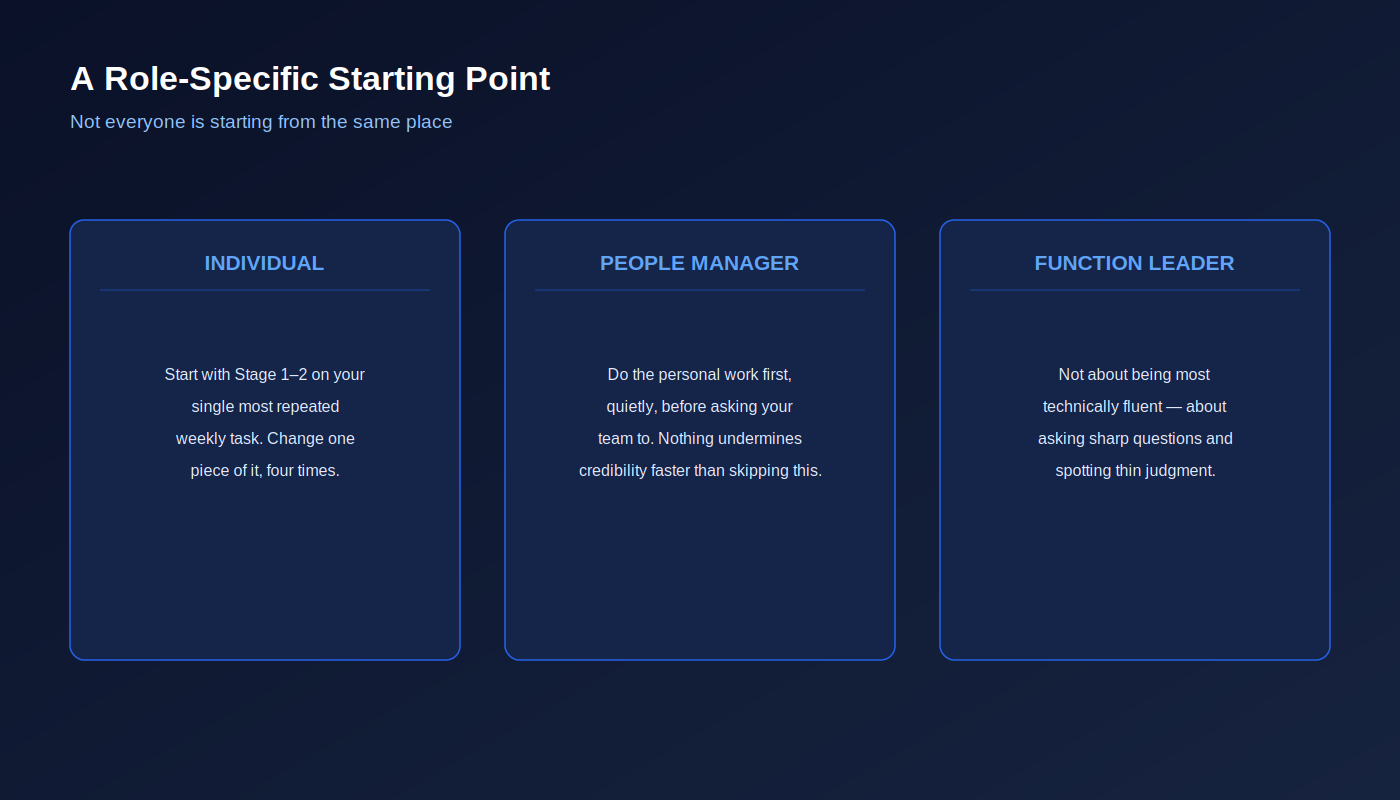
If you're an individual contributor: Start with Stage 1 and 2 on your single most repeated weekly task. Don't try to change your whole workflow — change one recurring piece of it, four times, and build from there.
If you're a people manager: Do the same personal work first, quietly, before asking your team to do anything. Nothing undermines a manager's credibility on this topic faster than pushing a tool they haven't personally struggled with.
If you're already leading a team or function: Your job isn't to become the most technically fluent person in the room. It's to have done enough Stage 1–3 work yourself to ask sharp questions, spot when someone's judgment is thin, and know which of your team's tasks are genuinely good candidates for this — versus which aren't.
A Starting Checklist
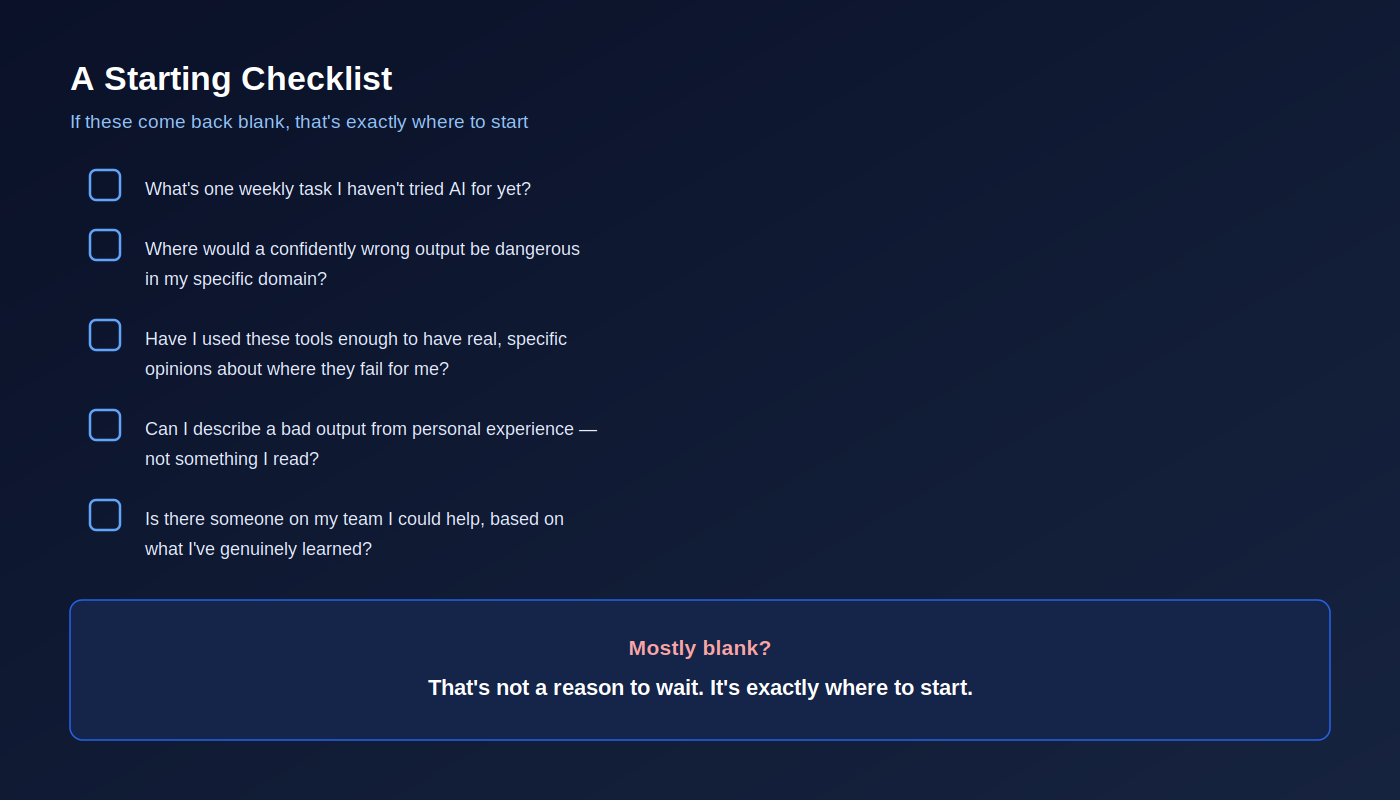
- What's one task I do weekly that I haven't yet tried using AI for?
- Where in my work would a confidently wrong AI output actually be dangerous — and do I understand why, specifically, in my domain?
- Have I used these tools enough this month to have real, specific opinions about where they fail for me?
- Can I describe, from personal experience rather than something I read, what a bad output looks like in my field?
- Is there someone on my team I could help get unstuck, based on what I've genuinely learned firsthand?
If most of these come back blank, that's not a reason to wait. It's exactly where to start.
Final Thought
Every macro conversation about AI — strategy, ROI, geopolitics, operating models — eventually comes down to people. Specifically, to how many people inside an organisation have done the personal work of building real fluency and real judgment, not just collected credentials that suggest they have.
Organisations don't transition. People do, one at a time, on real tasks, usually badly at first — and then organisations catch up to what their people already know how to do.
You don't need permission to start. You need one recurring task, this week, and the willingness to be genuinely mediocre at this for a little while before you're actually good at it.
About the Author
Arindam Banerjee is a technology executive with more than 21 years of experience leading enterprise technology transformation, AI strategy, digital transformation and large-scale delivery across global organisations.
If you're figuring out your own path into AI — whether you're an individual contributor, a manager, or a leader trying to help your team make this shift — I'd be glad to connect and exchange ideas.
Where are you in this transition right now — fluency, application, judgment, or leadership? And what's the one recurring task you haven't tried using AI for yet?