The Personal AI Toolkit — Episode 9 of AI Executive Insights Series
Search "best AI tools 2026" and you'll get a list of forty. Nobody needs forty tools. Nobody even successfully uses forty tools.
Episode 8 was about the four stages of a personal AI transition — fluency, application, judgment and leadership. This episode answers the question that naturally follows:
Which AI tools actually support that journey—and which ones are simply noise dressed up as productivity?
The answer is surprisingly simple.
Most of the tool landscape doesn't matter for your personal transition.
A small number of tool categories do—and choosing one tool per category matters far less than using it repeatedly against real work.
Why "Best AI Tools" Lists Don't Help You
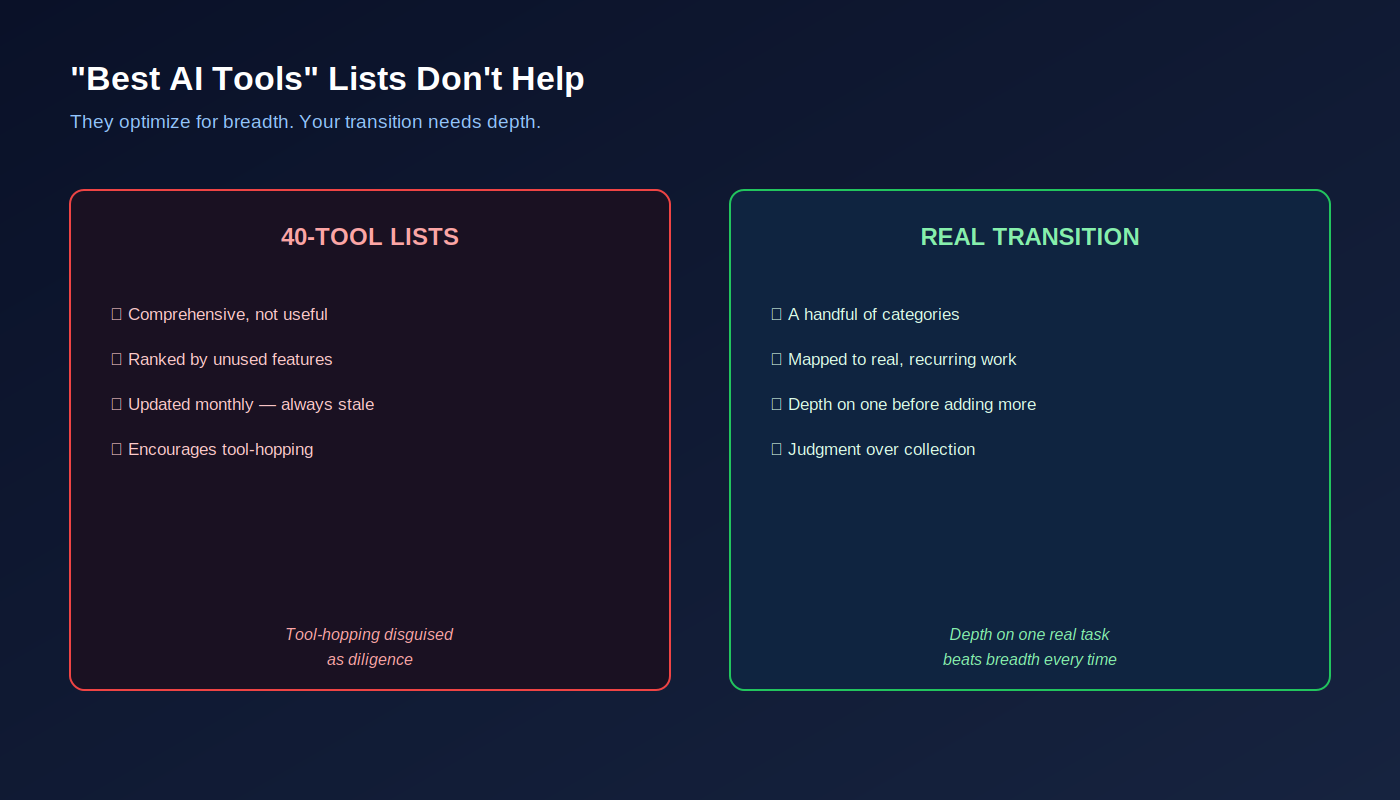
Every "best AI tools" list has the same flaw.
It's optimised to be comprehensive—not useful.
Forty tools across categories you'll never touch. Ranked by features you'll never use. Updated monthly because half of them disappear.
That's fine content for a newsletter.
It's a terrible strategy for building real AI capability.
As Episode 8 argued, depth on one recurring task beats breadth across dozens of tools.
Tool-hopping was one of the biggest mistakes that stalls progress.
A massive tool list simply disguises that behaviour as productivity.
Instead, map a handful of tool categories to the work you already do every week.
The Categories That Actually Matter
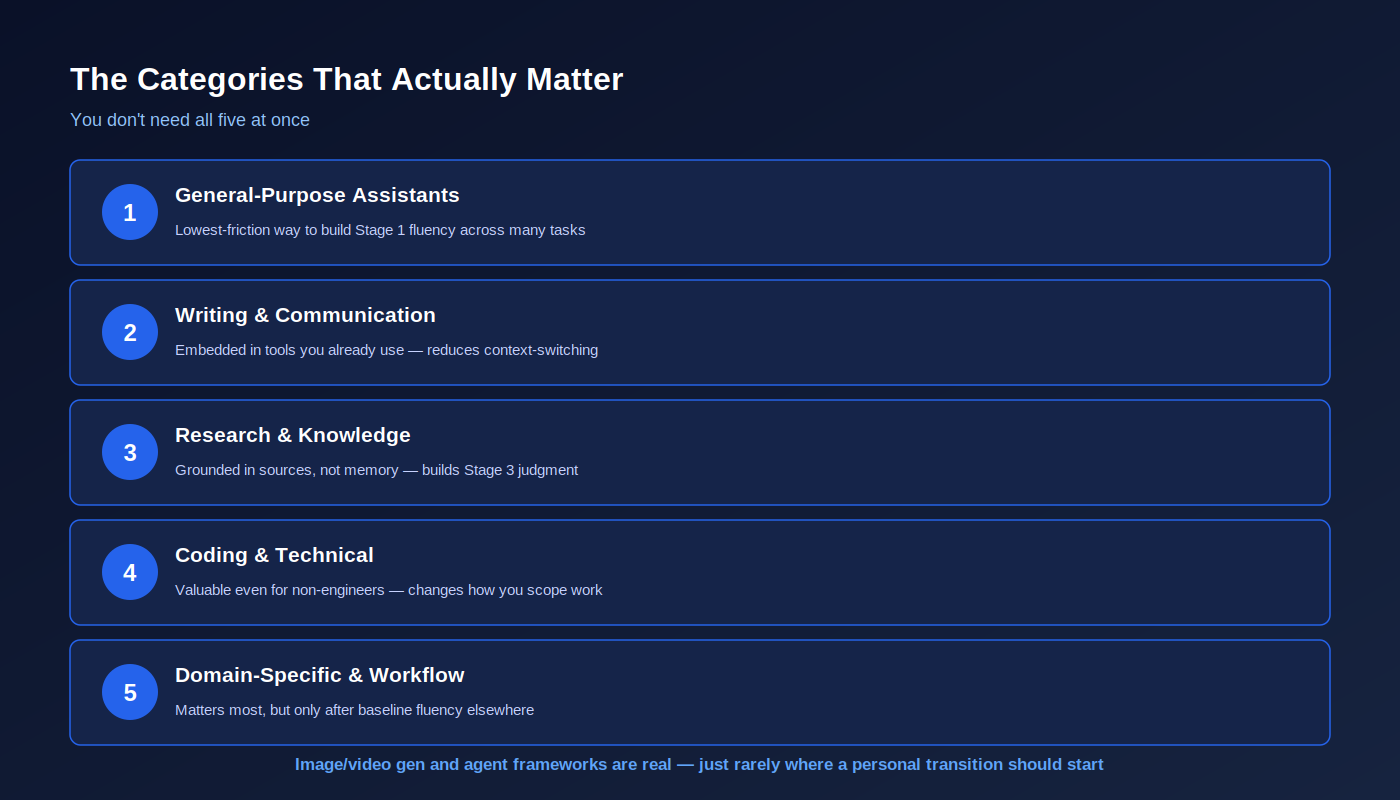
1. General-purpose assistants
Conversational AI for reasoning, drafting, analysis and research.
This is almost always the best starting point because it builds Stage 1 fluency across many tasks before you specialise.
2. Writing and communication
Email, reports, presentations and documentation.
Embedded assistants inside tools you already use reduce friction—and habit matters more than raw capability.
3. Research and knowledge
Tools designed to find, synthesise and cite real sources.
This category becomes critical for Stage 3 judgment because it encourages verification instead of blind trust.
4. Coding and technical
Even non-engineers benefit from basic coding assistants.
Automating spreadsheets, creating simple internal tools and understanding what's technically possible changes how you collaborate with engineering teams.
5. Domain-specific workflow tools
Sales. Legal. Finance. Design. Customer Support.
These often deliver the biggest productivity gains—but only after you've developed enough AI fluency to evaluate outputs critically.
Notice what's missing.
Image generation.
Video generation.
Agent frameworks.
They're valuable—but rarely where a personal AI transition should begin unless they're already central to your work.
Choosing Instead of Collecting
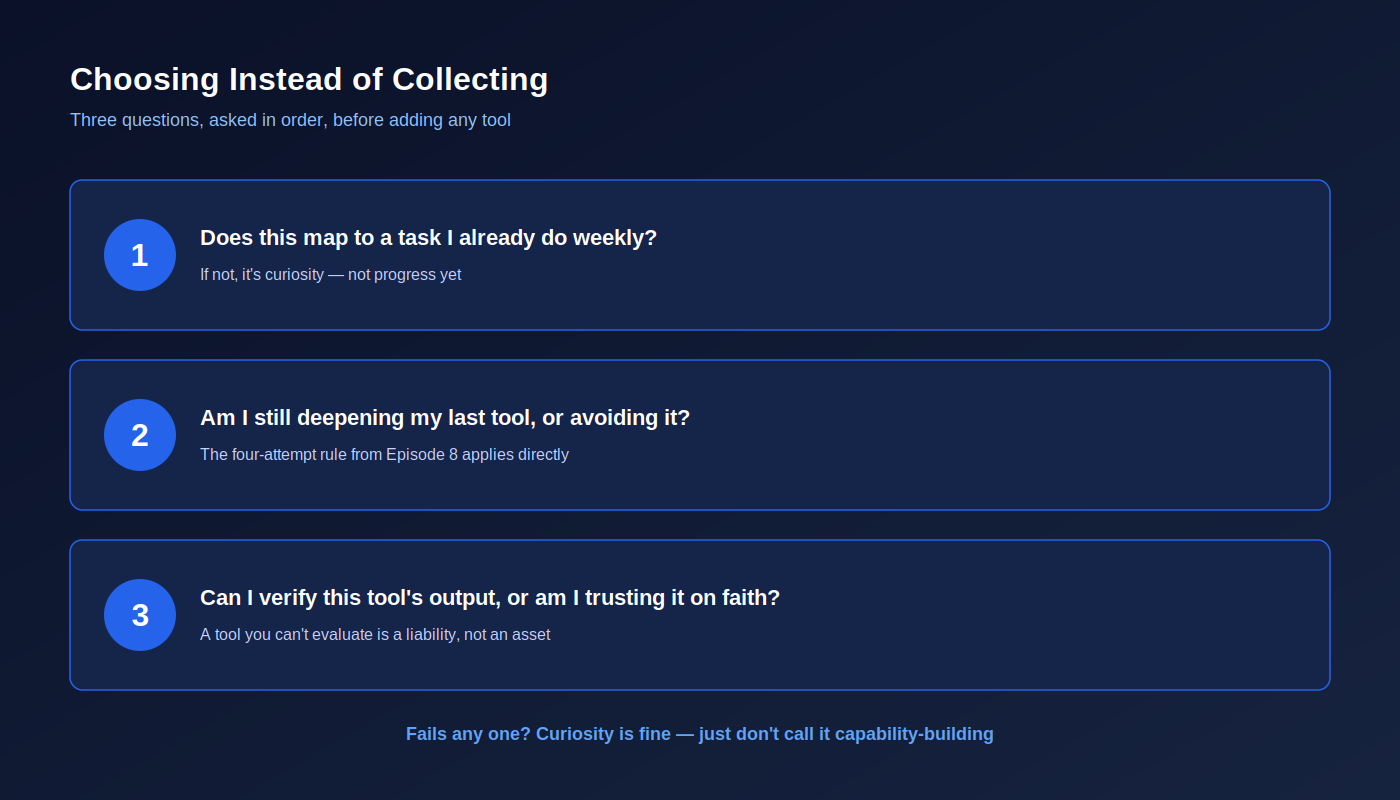
Before adding another tool, ask three questions—in order.
Does this map to a weekly task?
If not, it's curiosity—not capability-building.
Am I deepening my last tool?
Episode 8's four-attempt rule applies here.
If you haven't repeated the same task multiple times, another tool probably isn't the answer.
Can I verify the output?
This is the judgment question.
A powerful tool you can't evaluate becomes a liability.
If it passes all three, add it.
If not, keep exploring—but don't confuse exploration with progress.
What Changes Between Tools
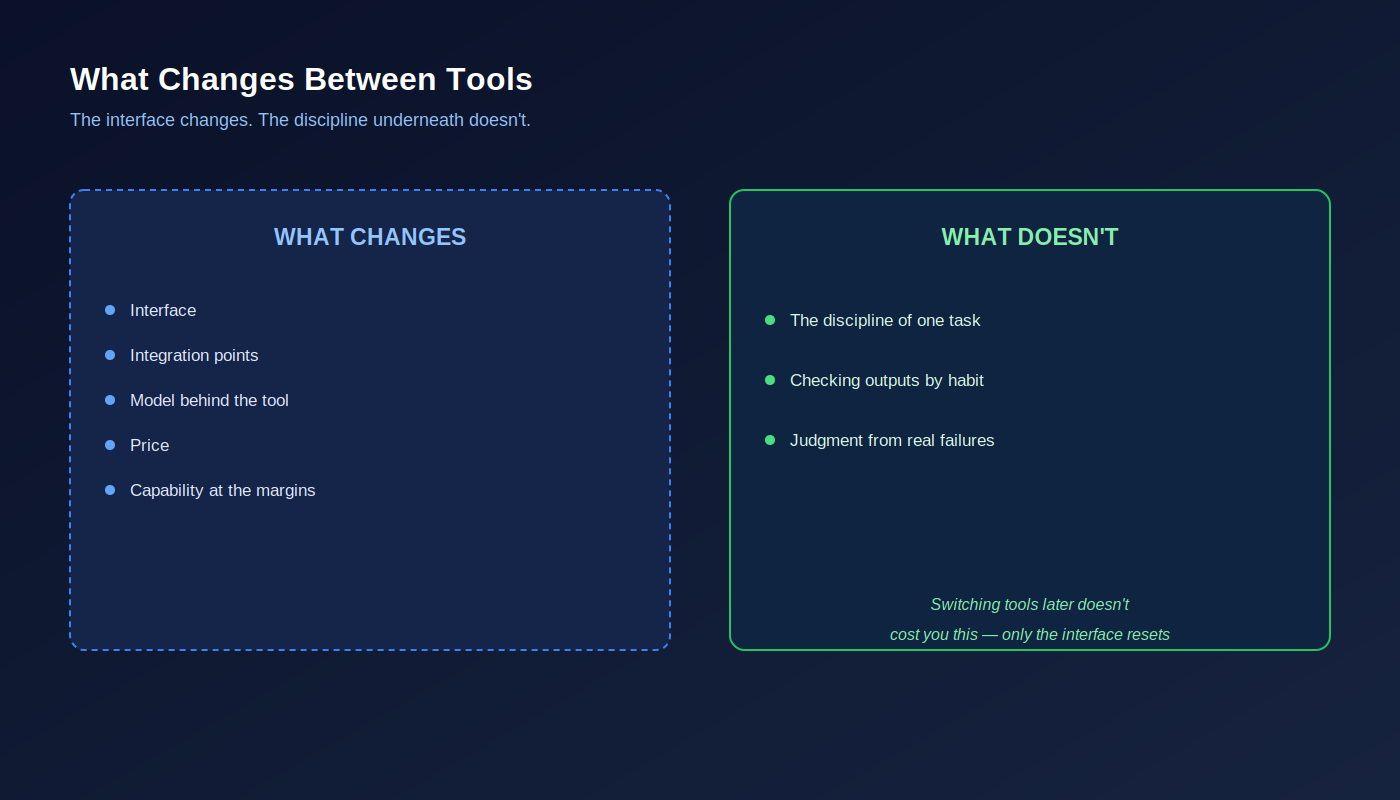
Marketing encourages us to believe the next tool changes everything.
In reality, much less changes than people think.
What changes:
- Interface
- Integrations
- Underlying model
- Pricing
- Marginal capabilities
What doesn't:
- Choosing one recurring task
- Checking outputs instead of trusting them
- Building judgment through real mistakes
That's actually good news.
Because when better tools inevitably arrive, your capability transfers.
Only the interface resets.
A Starting Checklist
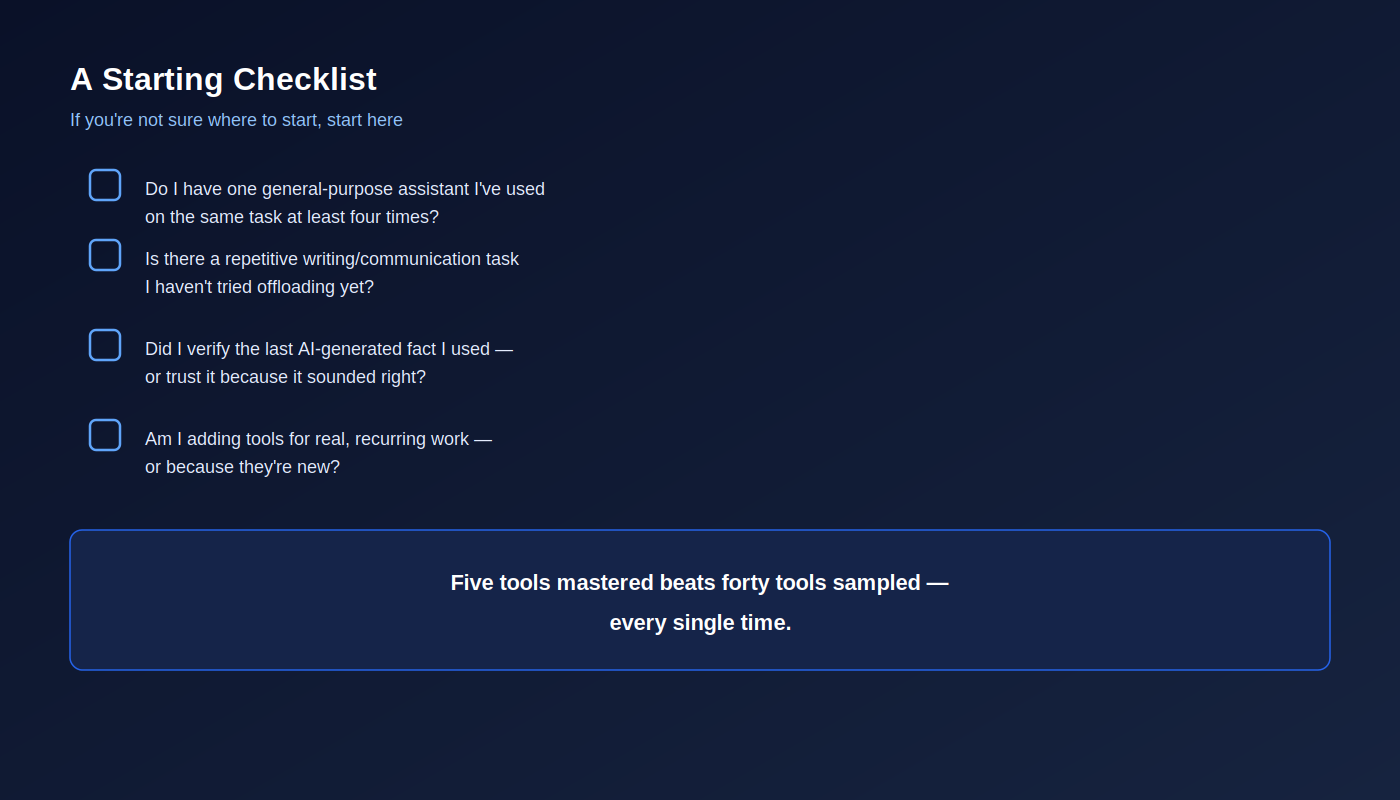
Ask yourself:
- Have I used one general-purpose assistant on the same task multiple times?
- Is there repetitive writing I haven't tried offloading?
- Did I verify the last AI-generated fact I used?
- Am I adding tools because they solve recurring work—or because they're new?
One honest answer is worth more than another downloaded app.
Final Thought
The AI tool landscape will keep changing faster than any list can track.
That's not a reason to chase it.
It's the reason not to.
What compounds isn't the specific tool.
It's the discipline.
Choose one recurring task.
Go deep before going broad.
Build enough judgment that every future tool becomes easier to evaluate.
The person who masters five tools will consistently outperform the person who samples forty.
About the Author
Arindam Banerjee is a technology executive with more than 21 years of experience leading enterprise technology transformation, AI strategy and large-scale delivery across global organisations.
If you're helping individuals or teams build practical AI capability—not just collect new tools—I'd be delighted to connect and exchange ideas.
Which category are you strongest in today—general assistants, writing, research, coding or workflow tools? And where's the gap you'll close next?