
(And What Successful Organisations Do Differently)
Enterprise AI is no longer an emerging technology. It has become a boardroom priority.
Across industries, organisations are investing heavily in Generative AI, AI Assistants, AI Agents and intelligent automation. Every week brings announcements of new models, new platforms and new capabilities. The pace of innovation is extraordinary.
Yet despite this excitement, one statistic continues to stand out.
Many Enterprise AI initiatives never progress beyond proof-of-concepts or isolated pilots. Others reach production but struggle to deliver measurable business value.
The question therefore is no longer "Can AI work?"
The better question is:
Why do some organisations successfully scale Enterprise AI while others fail to move beyond experimentation?
Over the last two decades of leading technology transformation programmes across industries, I've observed a recurring pattern.
Most Enterprise AI projects do not fail because organisations selected the wrong Large Language Model.
They fail because the organisational foundations beneath the technology are not mature enough to support AI at enterprise scale.
Why Enterprise AI Is Different
Many organisations still approach AI as if it were another software implementation.
It isn't.
Traditional technology projects focus on delivering systems.
Enterprise AI transforms how decisions are made, how employees work, how customers are served and how knowledge flows across the organisation.
That introduces entirely new challenges.
Questions such as:
- Can we trust our enterprise data?
- Who owns AI decisions?
- How do we govern AI responsibly?
- How do we integrate AI into existing business processes?
- How do we measure business value rather than model performance?
These are leadership questions rather than technology questions.
The organisations succeeding with Enterprise AI recognise this distinction early.
Those that don't often discover it after significant investment.
The Enterprise AI Iceberg Framework
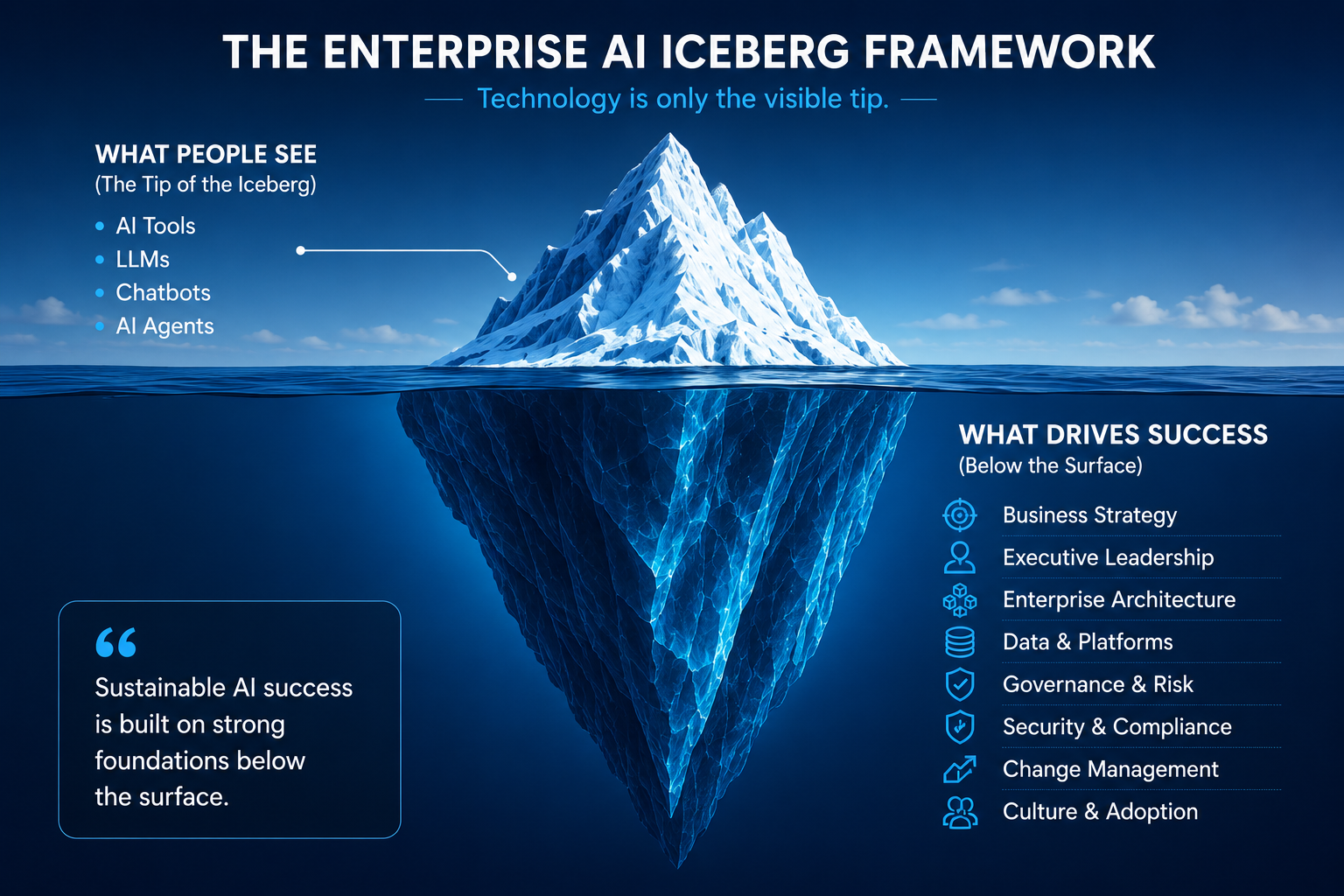
One of the biggest misconceptions surrounding Enterprise AI is that success is primarily determined by technology.
Executives naturally focus on the visible components:
- ChatGPT
- Copilot
- AI Agents
- Large Language Models
These technologies are important.
However, they represent only the visible tip of Enterprise AI capability.
The much larger—and more important—portion sits below the surface.
Below the waterline lie the capabilities that determine long-term success:
- Business Strategy
- Executive Sponsorship
- Enterprise Architecture
- Data Platforms
- Governance
- Cyber Security
- Change Management
- Organisational Culture
Technology attracts attention.
Foundations create business value.
Five Executive Failure Patterns
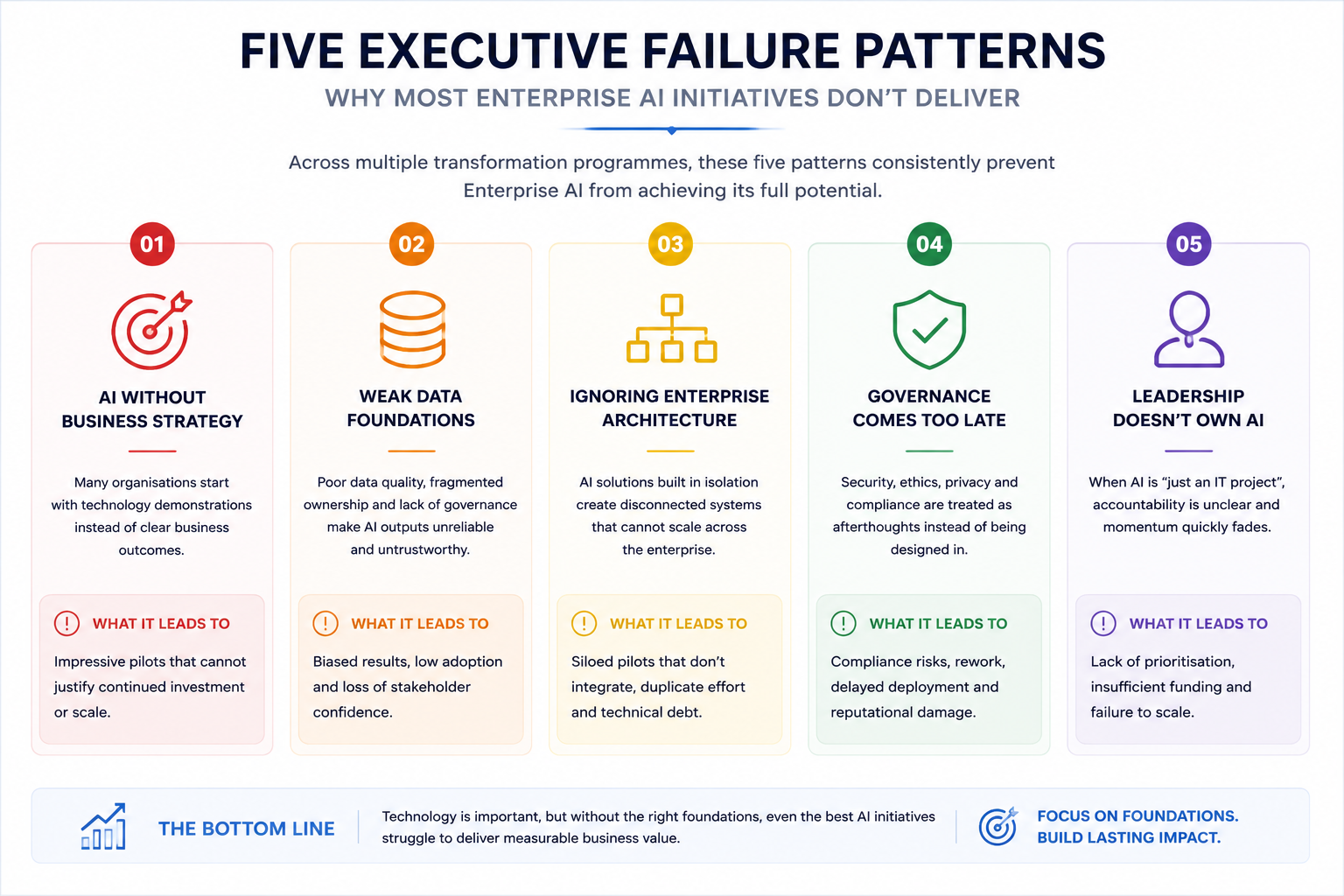
Across multiple transformation programmes I have repeatedly encountered five patterns that prevent Enterprise AI from achieving its potential.
1. AI Without Business Strategy
Many organisations begin with technology demonstrations instead of business outcomes.
The result is impressive prototypes that struggle to justify continued investment.
AI initiatives should always begin with a clearly defined business objective.
2. Weak Data Foundations
Enterprise AI is only as reliable as the data that supports it.
Poor quality, fragmented ownership and inconsistent governance significantly reduce AI effectiveness.
Before investing in larger models, organisations should invest in better data.
3. Ignoring Enterprise Architecture
Many AI solutions are implemented as isolated experiments.
Without scalable architecture and integration, those experiments remain isolated.
Enterprise Architecture provides the foundation that allows AI capability to scale across the organisation.
4. Governance Comes Too Late
Responsible AI cannot be treated as a compliance exercise after deployment.
Security, explainability, privacy, regulatory compliance and lifecycle management should be embedded into every AI programme from the beginning.
5. Leadership Doesn't Own AI
Perhaps the biggest challenge isn't technical.
It's organisational.
When AI becomes "an IT project," executive sponsorship weakens and accountability becomes unclear.
Successful organisations position AI as a business transformation programme led by executive leadership.
The Enterprise AI Success Stack
Rather than viewing AI as a single implementation, successful organisations build capability progressively.
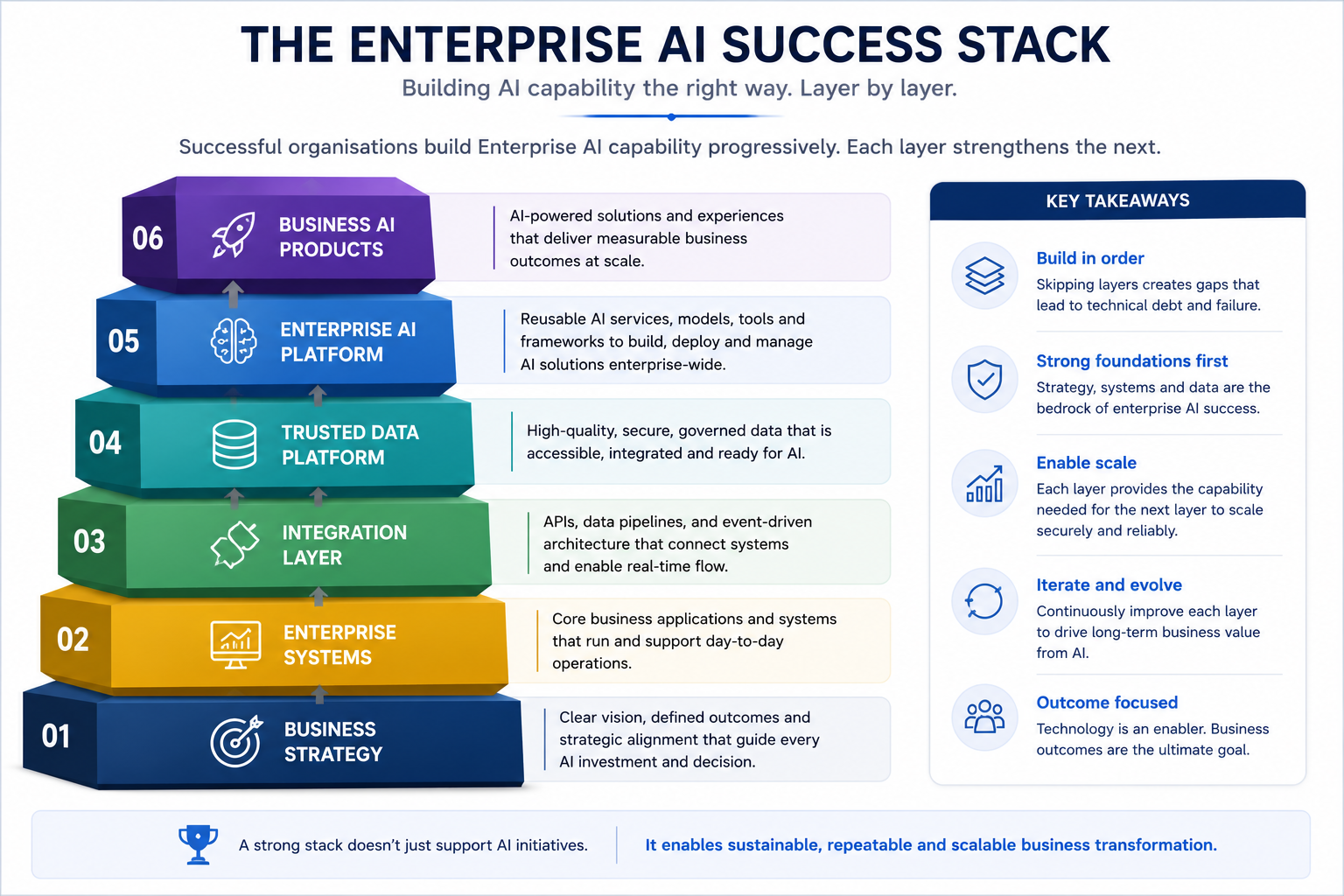
The journey typically follows this sequence:
Business Strategy
↓
Enterprise Systems
↓
Integration Layer
↓
Trusted Data Platform
↓
Enterprise AI Platform
↓
Business AI Products
Each layer strengthens the next.
Skipping layers often creates technical debt that becomes increasingly expensive to resolve.
Moving From Pilot To Enterprise Scale
One of the most difficult transitions in Enterprise AI is moving beyond successful proof-of-concepts.
A pilot usually succeeds because the environment is tightly controlled.
Enterprise deployment introduces new realities:
- Multiple business units
- Legacy applications
- Security requirements
- Regulatory compliance
- Performance monitoring
- Cost optimisation
- Continuous model improvement
Scaling AI therefore requires much more than deploying another model.
It requires an operating model capable of supporting AI as a long-term business capability.
An Executive AI Maturity Model
In my experience, organisations generally progress through four stages.
| Stage | Characteristics | |--------|-----------------| | Experimenting | ChatGPT, pilots and isolated use cases | | Operational | Governance, integrations and reusable components | | Scaling | Enterprise AI platforms and standard operating models | | Transforming | AI embedded into business strategy and core processes |
The objective isn't simply to adopt AI.
The objective is to build organisational capability that continuously creates value from AI.
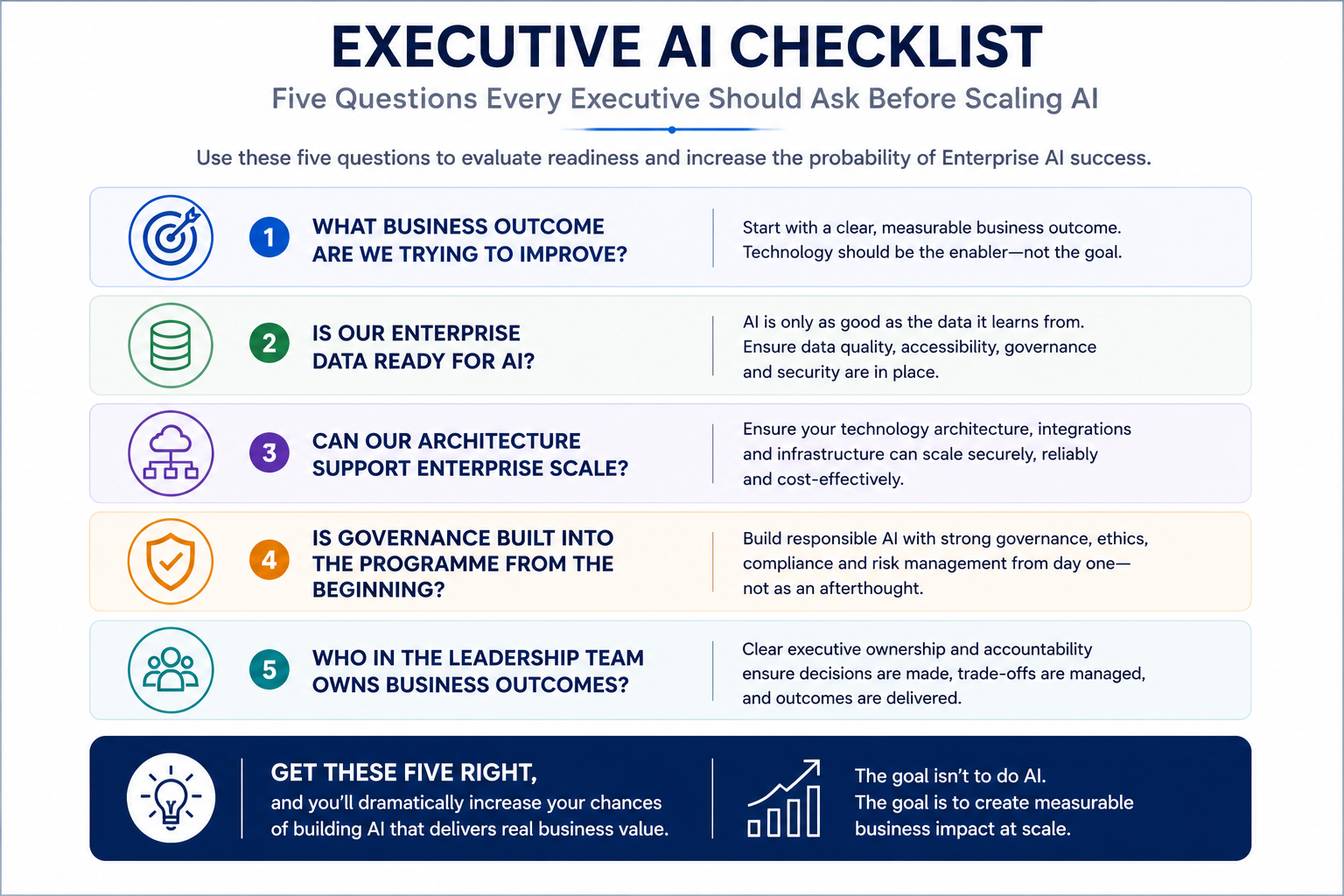
Five Questions Every Executive Should Ask
Before approving any Enterprise AI investment, leadership teams should ask:
✅ What business outcome are we trying to improve?
✅ Is our enterprise data ready for AI?
✅ Can our architecture support enterprise scale?
✅ Is governance built into the programme from the beginning?
✅ Who in the leadership team owns business outcomes?
These questions often determine whether an initiative becomes another pilot—or a genuine competitive advantage.
Final Thoughts
The AI landscape changes almost every month.
New models emerge.
New capabilities appear.
New tools attract headlines.
Yet the foundations of successful Enterprise AI remain remarkably consistent.
Clear strategy.
Trusted data.
Scalable architecture.
Responsible governance.
Strong executive leadership.
Technology will continue to evolve.
These principles rarely do.
The organisations that recognise this distinction won't simply adopt AI.
They will build sustainable competitive advantage through it.
About the Enterprise AI Leadership Series
The Enterprise AI Leadership Series shares practical frameworks, executive perspectives and lessons learned from real-world technology transformation programmes.
The objective is simple:
To help organisations move beyond AI experimentation and build Enterprise AI capabilities that deliver measurable business value.
If this article resonated with you, I'd be delighted to hear your thoughts or continue the conversation on LinkedIn.